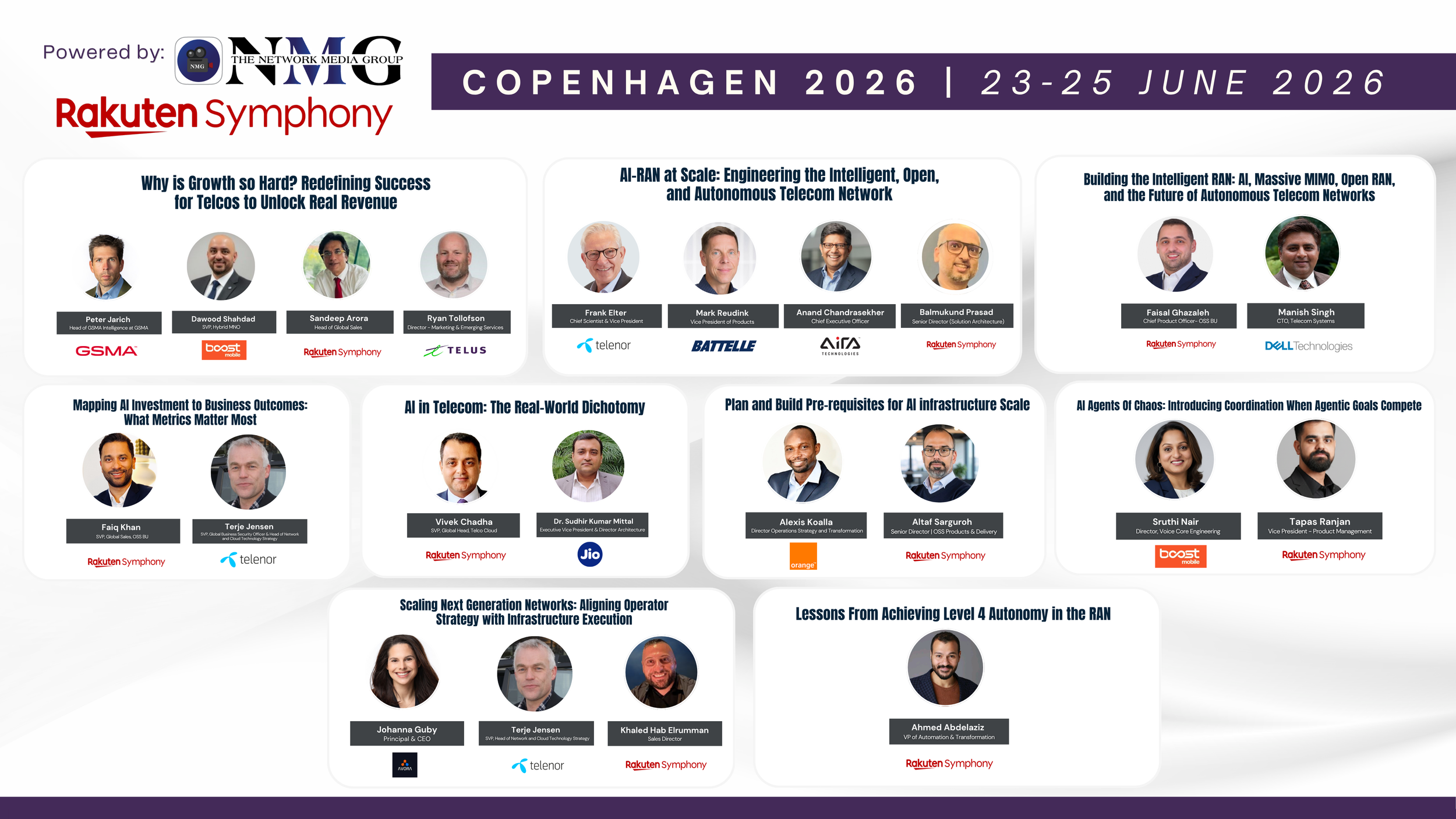
Copenhagen 2026: NMG Program, hosted by Rakuten Symphony

Session Title: Plan and build pre-requisites for AI infrastructure scale

Automation and AI grab the headlines, but telco scale can’t happen without infrastructure plan, build, orchestration and assurance doing the heavy lifting.

What does it take to move from fragmented, manual processes to a unified, AI-ready foundation? Let’s explore how complex, distributed environments across telecom, tower companies, data centers and even EV networks can be designed and operated as a single system that intelligently maps network assets, topology and inventory. Stakeholders from across the industry will discuss how to manage distributed infrastructure at scale and get the fundamentals right to unlock higher levels of automation, agility and service innovation.

Session Title: Why is growth so hard? Redefining success for telcos to unlock real revenue

Despite years of transformation and operational success, many telcos struggle to deliver sustained top-line growth. As revenue pressure proliferates, efficiency alone is not changing business outcomes.

This panel tackles the uncomfortable questions swirling around persistent growth problems: Why is growth so hard? Has telecom over-rotated on cost optimization at the expense of new value creation? What role do AI, platforms and ecosystem plays have in unlocking real revenue versus incremental gains?

Join industry leaders as they debate what it takes to move beyond efficiency and toward undeniable growth, with practical strategies, real-world examples and an honest look at what’s working (and what isn’t).


Session Title: Global Connectivity at Space Scale: Operationalizing NTN Without Satellite Silos

Satellite providers and MNOs are racing to integrate and operate fundamentally different networks as one. But non-terrestrial networks (NTN) demand unique architectures, performance models and operational complexities that don’t fit traditional telecom frameworks.

How to avoid creating isolated “islands” of satellite operations? What does it take to scale across hundreds of operator partnerships? And what are the key pitfalls to avoid when building a future-ready, heterogeneous network strategy?

This panel explores how to abstract NTN complexity into a unified operational layer and translate vendor and network-specific signals into a common language that ensures consistent service assurance, regardless of underlying technology.

Join industry leaders to discuss practical approaches, early learnings and what it takes to make seamless, integrated NTN connectivity a reality.

Session Title: AI-RAN at Scale: Engineering the Intelligent, Open, and Autonomous Telecom Network

As telecom operators accelerate the transition toward AI-native, cloud-native, and software-defined network architectures, the industry is entering a pivotal phase in the evolution of the radio access network. AI is rapidly moving into the RAN—from energy optimization and predictive maintenance to Massive MIMO tuning, intelligent orchestration, and near real-time automation through Open RAN and RAN Intelligent Controller (RIC) frameworks. But as AI-driven functions, vendors, and orchestration layers proliferate, a critical question emerges: are operators building truly autonomous, scalable networks—or creating fragmented layers of intelligence that increase operational complexity?

This panel brings together telecom operators, Open RAN innovators, infrastructure providers, and applied research leaders to explore how AI-RAN is evolving from experimentation to measurable operational impact. The discussion will examine where AI-driven RAN architectures are delivering tangible improvements in network performance, spectral efficiency, energy consumption, automation, and customer experience—and where interoperability, orchestration, and integration challenges still remain.

Panelists will explore how Open RAN, cloud-native infrastructure, and Massive MIMO technologies are converging to create more adaptive, software-centric wireless networks capable of supporting increasingly autonomous operations. The session will also examine the role of AI and machine

learning in enabling self-optimizing and self-healing networks, intelligent resource allocation, predictive analytics, and dynamic optimization across distributed edge, core, and radio environments.


Session Title: AI Agents Of Chaos: Introducing Coordination When Agentic Goals Compete

AI agents are being optimized toward competing goals. Without coordination, efforts to reduce energy usage, improve coverage and minimize dropped calls create tension, unpredictability and risk.

This panel explores the balance required to orchestrate multiple AI agents to work together effectively. We’ll discuss where humans should remain in control and what decisions can be automated safely, while governance, guardrails and operating models are optimized to move from experimentation to production?

Join us for a conversation about bringing structure, control and trust to AI-driven networks to avoid the trap of intelligent chaos.

Session Title: Mapping AI Investment To Business Outcomes: What Metrics Matter Most

We are reaching a critical juncture in the AI hype cycle: deployments are real but are the business impacts worth the investment?

Businesses that have defined success based on who could use the most tokens are having a moment of reckoning as they attempt to draw a clean line between AI-driven productivity and business outcomes that matter. This panel assembles telco leaders prioritizing AI investment to focus on tangible outcomes like revenue growth, cost efficiency and operational transformation.

Join this discussion to explore a new phase of telco AI grounded in accountability, honest economics and real-world results.

Session Title: Lessons From Achieving Level 4 Autonomy in the RAN

At MWC Barcelona 2026, Rakuten Mobile became the first operator to receive TM Forum Level 4 validation for RAN energy efficiency optimization in a live Open RAN network, delivering 20% energy conservation with no human approval required for network actions.

Achieving Level 4 is a system design challenge with operators tending to underestimate what’s required. From unifying data infrastructure and implementing intent and policy management to deploying decision engines and safe execution logic, there are a range of hurdles to clear. Which are non-negotiable and which can wait as telcos plot individual paths to autonomous operations?

This panel brings together the practitioners who built, certified and are now scaling Level 4 systems to share what they have learned. We’ll cover what the TM Forum certification process reveals about real operational gaps, how the five foundational layers interact and where most implementations break down, why governance and organizational readiness matter as much as architecture, how trust is engineered into autonomous systems incrementally rather than assumed, and what the path forward looks like for operators at different stages of the autonomy journey.

Title: AI in Telecom: The Real-World Dichotomy

Abstract:  At TM Forum Innovate Asia 2025, operators reported significant gains through autonomous network initiatives, including more than 70% improvements in service activation efficiency and substantial reductions in network downtime. By early 2026, Rakuten Mobile achieved the industry's first TM Forum validation for Level 4 Autonomous Network operation in RAN Energy Efficiency Optimization, demonstrating approximately 20% energy savings through AI-driven closed-loop automation on a live Open RAN network.

These milestones represent genuine progress. Yet they also expose a critical industry dichotomy.

While Level 4 autonomy has proven highly effective in narrow, well-defined use cases such as energy optimization, fault management, and targeted operational domains, the transition to cross-domain, intent-driven autonomous operations remains a fundamentally different challenge. Most operators continue to rely on human oversight for critical decision-making, reflecting an industry-wide recognition that trust, governance, and operational maturity must evolve alongside the technology.

The barriers to broader adoption are no longer primarily technological. Instead, they lie in fragmented data architectures, legacy OSS environments, operating models designed around manual workflows, procurement practices that prioritize headcount over outcomes, and the absence of an effective control layer capable of orchestrating increasingly sophisticated AI systems.

As telecom leaders move from experimentation to scaled deployment, the key question is no longer whether AI can automate network operations. The question is whether organizations can transform quickly enough to realize its full value. This session explores the growing gap between technological capability and organizational readiness, and examines what operators, vendors, and industry stakeholders must do to bridge it.

Sign up for Daily CommTech Brief here.


For any inquiries, please email anejad@thenetworkmediagroup.com

Abe NejadPinned