
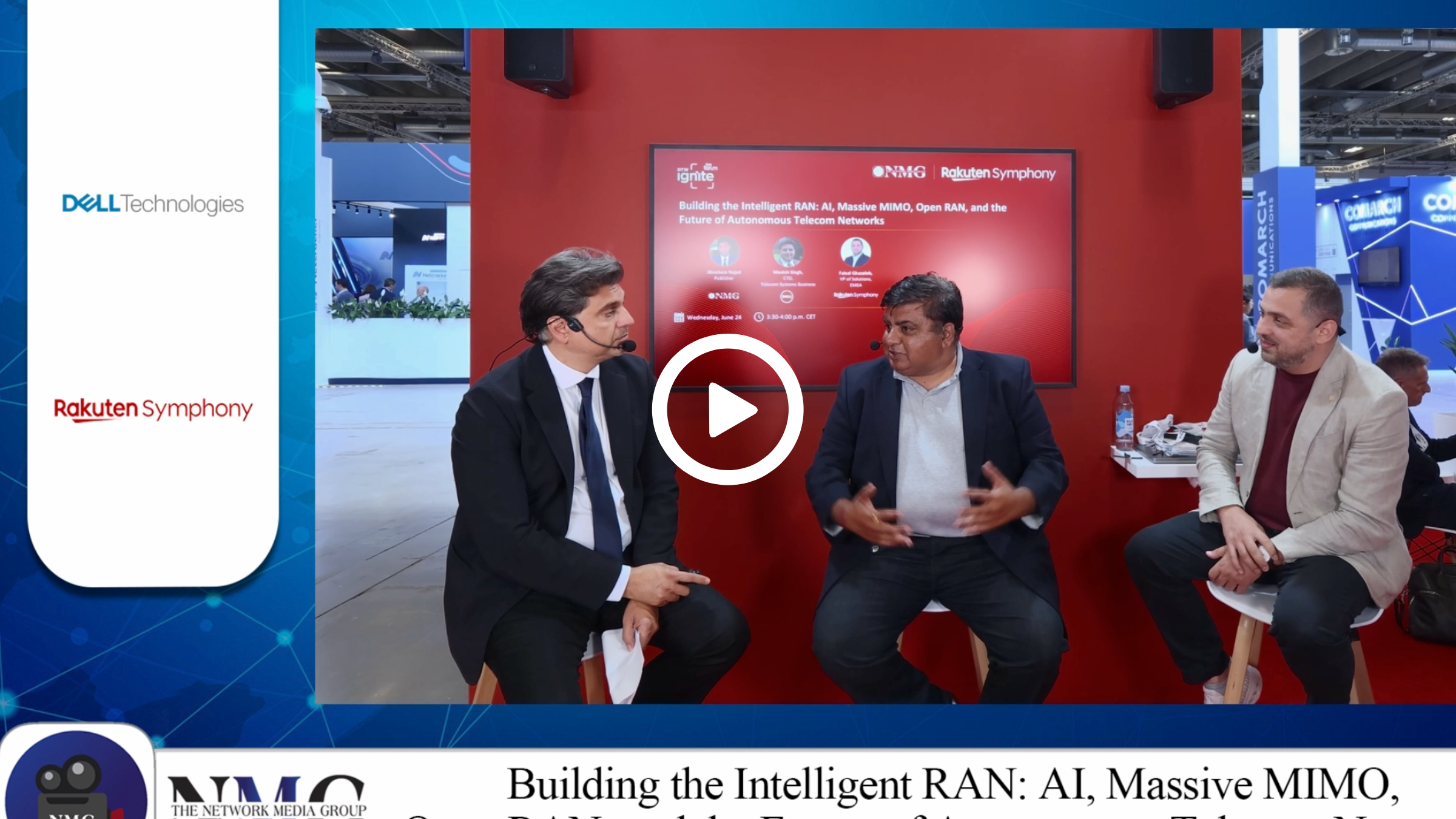
Building the Intelligent RAN: AI, Massive MIMO, Open RAN, and the Future of Autonomous Telecom Networks
OBJECTIVE:
What are the practical realities of Open RAN deployment, including integration complexity, orchestration challenges, performance consistency, cybersecurity exposure, and the need for standardized interfaces across multi-vendor ecosystem. Joining us to give us insight are Manish Singh, CTO, Telecom Systems at Dell, next is Faisal Ghazaleh, VP of Solutions - EMEA, Rakuten Symphony.
SPEAKERS:
Manish Singh, CTO, Telecom Systems, Dell
Faisal Ghazaleh - VP of Solutions – EMEA, Rakuten Symphony
TRANSCRIPTION
ABE: And what are the practical realities of Open RAN deployments, including integration complexity, orchestration challenges, performance consistency, cybersecurity exposure, and the need for standardized interfaces across multi-vendor ecosystems. Joining us to give us their insight are Manish Singh, he's Chief Technology Officer, Telecom Systems, that at Dell. And next to Manish is Faisal Ghazala, he's Vice President of Solutions, EMEA, that at Rakuten Symphony.
And gentlemen, welcome.
MANISH: Great to be here.
ABE: We're here at the tail end of day two of this conference here in Copenhagen called DTW.
You guys aren't too tired yet?
**FAISAL:**No,
MANISH: No, I'm feeling good.
FAISAL: Still, yeah, still going. Yeah. Let's see how it's pretty exciting. So it keeps us up.
ABE: Absolutely! So taking a little bit from the title of the session, Faisal, I'm going to start with you, if you don't mind. Certainly, Massive MIMO being scaled right now, also a cornerstone of advanced 5G and 5G deployments. What are the operational and really technical challenges that operators are facing while they scale Massive MIMO?
FAISAL: Yeah, I think, first, Massive MIMO has been a great thing which has been introduced to the market, especially that it deals with one of the biggest challenges that we have, which is the spectral efficiency.
So since that has been basically introduced, we have seen 2 to 4 times increased capacity where it was deployed, 80% penetration into the market. There is a very good application, especially in the mid band. However, when we speak about the challenges, I think the applicability of that Massive MIMO technology is a little bit limited to a mid band again, because that is where we can have a logical size of the form factor with the wavelength and the size of the antennas.
So when you speak about 64T, 64R, you can basically have a logical size of the form factor. But when you speak about the low bands, then the antenna requirements go bigger and then it gets more complicated. Of course, with that comes the energy consumption, also the uplink limitations.
So these are the main limitations as well as it only applies basically to the dense areas. That's where you see the biggest gains. Otherwise, you go outside to the ruler and urban, then it gets a little bit more less value out of it.
So that's where we see a little bit of challenges. There is a way to deal with all these challenges, by the way, but that's what we have seen so far.
MANISH: Yeah, mid band, good scattering environment, and you start to see the gains.
ABE: Manish, I do want to ask you sort of a general high level question about AI and maybe from your perspective at Dell about how AI and machine learning are really impacting different areas. I mean, I'm going to mention beamforming, radio resource management, spectrum utilization, not necessarily those in particular, but if you want to mention those, fine. But just from your perspective, where on the timeline do you feel like you are at Dell with respect to AI and ML, and do you think it's moving at a pace that you're comfortable with?
MANISH: Yeah, I mean, first of all, right here in Copenhagen, walk around and everywhere, everything you see is around AI, AI, agentic AI, and more.
And I think in the world of telecom, it's going to get broadly applied and adopted from network cooperations to customer care, but as well, to your point, in the radio access network. If we talk about AI and the RAN, I'll break it down into two parts, AI in the RAN, AI on the RAN.
When we think about from an AI in the RAN, the opportunity is immense. Again, to the point earlier around improving spectral efficiency, spectrum is a limited resource, it's an expensive resource, and we want to extract the most out of it. So when we think from a spectral efficiency perspective, whether you think from channel estimation to link adaptation to better scheduling, the opportunities are immense and across the radio access stack, from layer one, layer two, from a scheduling perspective and onwards. So that's the opportunity inside the radio access network itself.
Then think about from a network operations perspective, network planning perspective. And I think I tend to think about it from a network lifecycle perspective, from planning, install, commission to operations, troubleshooting, optimization, and AI is going to play a key role across that network lifecycle. So that's all about AI in the RAN.
There's the other opportunity about AI on the RAN, and this is just emerging, it's taking shape as we speak, especially as operators are thinking about AI grid, which is the concept around distributed AI infrastructure, especially targeted for inference. Because the question is, where does inference belong? Is it in the cloud? Is it in the core? Is it on the edge? And edge is that priceless real estate for the operators, where they have the opportunity to really bring inference closer to where the data is, where the users are. And so I think that AI on the RAN, on the AI grid, is a key emerging opportunity for the telcos.
ABE: Do you want to comment about AI on the RAN? I feel like that's an interesting...
FAISAL: Yeah, of course. I mean, we also see, as basically Manish mentioned, we see the need for AI on the edge, and that is something even the 6G is going to adopt as part of the standard. So we expect to see some basically standards coming in that sense.
The use cases are basically there and low-hanging fruits, such a great opportunity. But yet we will need also the AI to apply the different levels and hierarchy of the network, because certain decisions doesn't have all the inputs at the edge. So certain more macro decisions has to be taken at the higher level of the networks, and these two things has to work collaboratively.
But definitely pushing more things to the edge makes the edge smarter, save on the back and forth transportation and the traffic, as well as make us react faster, which is something we have not had in the network so far. This is going to be pretty revolutionary, enabling and opening more use cases, enabling more sensitive and mission critical use cases, improve reliability as well. And then the other AI aspects are going to happen at the macro level, are going still to be needed to manage more strategic network strategy decisions that goes across nationwide or certain provinces and so on.
So I see a bit of both going to be needed for sure, yeah.
MANISH: And maybe just one more thing, since you talked about MIMO and massive MIMO earlier, AI opens another interesting opportunity in that domain, especially from a beam forming, beam management perspective, as well as multi-user MIMO from a user pairing perspective. So anytime, I mean, the broader construct I would say is the classical optimization problems that are out there, AI applies to those very well, and therein lies the opportunity.
ABE: Faisal, I want to go back to you, as AI-RAN intelligence really kind of proliferates, what are the metrics by which operators can measure the success of AI-RAN, even now? I know there's ARPU and churn rate and those types of things. From your perspective, what are those KPIs metrics?
FAISAL: I think it's a very interesting question, and I think the industry was a little bit victim of the metrics they have chosen for themselves, because you become what you measure, actually. And today, people are starting to pay more attention to this. One of those CSPs, which has been a pioneer in basically advocating for introducing new KPIs is Rakuten Mobile, and I invite you to look at our 2026 growth report, where we have tackled this point. In fact, churn rate, for example, let's take it as an example, has been a little bit misleading, because certain CSPs have been losing 1,000 customers of high ARPU, rich customers, and gaining another 1,000 students, and for them, the churn rate remains intact and everything is okay. But the mix of their subscribers has degraded massively, and the KPI did not catch that.
Same time, when we speak about the ARPU, I mean, we go for the ARPU, which is completely agnostic to the margin, and you might be getting the highest ARPU customer, but you are paying more in the price defense. And eventually, you are not making the right margin. So these KPIs lacked the real substance and the real direction for the business where we want to go.
It's not fulfilling that. We now see a new introduced KPIs like the lifetime value of the subscriber and how much that subscriber invests with you over a lifetime. Then what is the cost of acquisition for those subscribers and the ratio between the LTV and the cost of acquisition in order to know how much you are on the right track from a business perspective. So I think within the AI era, we need to start on the right track from the beginning and we need to refresh our measurements, our metrics, in order not to be blind about the performance of our industry when it's too late. So I see introducing these new things in our financial reports like what we call the AI EBITDA. Today, some of the CSPs and some of the solution companies say we are actually using AI and AI is pretty much deployed and look at our token consumption. And that doesn't mean anything. Maybe you are writing emails with the consumption. I need to look at the financial new KPI, which is called AI EBITDA, for example. And that is a real reflection of the AI I want to see. Because at the end of the day, AI is a capability which can be used in many, different ways. Unless it contributes to your EBITDA, it's not fulfilling the purpose. So I think we need to do a little bit more work on that front.
ABE: Interesting. Manish, yeah go ahead.
MANISH: I think very well said. And I was just going to build on this point. I think the risk or the challenge right now with AI is it's a technology that can be applied in so many domains. And the risk here is that you can go and start applying in a lot of areas where the returns might just not be there.
And so the question around governance comes in. How do you actually really go for the biggest impact? And I'll give a very simple two by two for any business to look at. Where is your spend? Where is your data? Look at your spend, the highest spend items, look at your data readiness and the answers.
For us at Dell, we looked at it and we know we have very high spend on R&D, on product development, on sales and marketing, support and services, as well as on supply chain. And those are the areas where we have focused on. And to actually, to your point, really start measuring the true business impact of applying AI.
So I think as much as it applies to us, it applies to any business to really look at and make sure there's good governance framework as you look at from an AI perspective. And it as much applies to a radio access network as it would to a core as to a network operation on and on for the telco.
ABE: Yeah. Ah Faisal, I'm going to go a bit off script here. I'm going to ask you a question and certainly jump in as well. We've been having these discussions about the advancement of Open RAN for a number of years now. Building the Intelligent RAN is the title of this session. Some of the conversation is a bit repetitive. We might bring up some points from previous discussions and then some of it's a bit maybe bleeding edge if you want to describe it that way or more progressive if you want to describe it that way.
What are we missing? What are we not talking about? Just from a discussion thought leadership level when we're talking about building the Intelligent RAN, what's missing? Like, why isn't this moving faster?
FAISAL: I think, again, it's the commercial angle. I mean, we have been stuck in the G trap in this industry from 2G to 3G.
ABE: And now we're talking about the next G.
FAISAL: Yeah, Exactly.
ABE: And we're talking about that'll be the discussion for the next two years.
FAISAL: Yeah. And I think the underlying reason for that is that this industry formation is heavy on engineers as business basically leaders. And you see even some of the leaders in the industry or most of the leaders in the industry comes from engineering background, which is needed. But we need to reinforce the commercial angle, the business angle, and we need to do more basically commercially driven decisions. We need to reassess our decisions based on the commercial outputs and align with the industries and so on. So that is something we expect 6G to fix because 6G, one of the primary reason and a primary purpose now that they would like to cover a lot of the gaps that we have seen in the 5G since 5G was an excellent technical solution, but it was not monetized properly for most of the adopters. And that is the thing now, which has to drive every conversation out there in the market. And for that, we need a complete mindset change.
We need the business people to be leading and we need the technical people to be supporting and realizing the vision of the business people. Yeah.
ABE: Well said by the way, but would you agree or disagree with any of that?
MANISH: Ohh. I can't agree more.
I think we as an industry in the mobile industry have been operating on a decade per G cycle, whereas the technology world around us is moving at a very fast pace. I mean, just look at AI. We were talking about models, chatbots and chat agents to then all of a sudden we had RAG, now we have agents and agentics.
Who's to tell in the next 6 months to 12 months what's going to happen on these models and the frameworks around? And yet we are talking about another decade cycle that has to change. And I will summarize it in two key things.
Number one, hardware, software, disaggregation, modernization of the network, make it more cloud native so you can actually increase the innovation speed and the innovation cycle.
Two, AI is here and now. And the worst AI we have is the AI today, i.e. it's only going to get better. And so we really need to think about how do you unlock the value of that as you start to develop the blueprint right from the early start.
ABE: Well said as well… So we hope maybe this time next year we have discussions that again move maybe beyond the technology and more towards the business and the consultative side to your clients and customers. And that conversation is certainly happening.
**FAISAL:**Yeah.
ABE: But maybe just not at a pace that, you know, I thought it would be a little accelerated more over the last two or three years than it is.
FAISAL: Yeah.
ABE: Just from my perspective.
FAISAL: I think it's now the industry has learned the hard way. So it's definitely being pushed hard and the industry is adapting.
Now it doesn't take only the CSPs to take that call. It's an ecosystem change. So even the standards, the TM forum has to align with that objectives, then the CSPs, then we are the solution providers, the stakeholders of the technology has to all revolve our basically value proposition around those major industry commercial objectives.
And I see it already happening. I see more of it will happen with the next wave of investment because now we are in between two technologies. The 5G is quite mature and it becomes a little bit mature. So most of the investments are tactical at this stage in terms of the infrastructure, but coming closer to 2029 when the 6G releases out there, we expect to see another wave of investment and we should become smarter in attracting the verticals because I think the market is saturated with mobile individual users. So we need to look more in depth into the health and care, oil and gas, the retail industries, and we understand those verticals in order to bring them in.
ABE: Yeah Because the verticals don't care about open RAN. They care about the solutions.
FAISAL: Exactly. We need to sell outcomes.
So the data bytes and the minutes doesn't mean anything for them. I need to save them less downtime in the logistics business, for example, and so on. So the more we become closer to them, the more we can bring them in and then we can bring the revenue more to this industry and flourish and go to the next step.
**ABE:**Yeah, for sure.
MANISH: I keep agreeing with him.
ABE: You're stealing the show. (refers to Faisal)
FAISAL: It's a big privilege.
MANISH: I keep agreeing with him and that's right. I mean, I'll tell you the success of the mobile operators today, if you look at it, is their go-to-market machine, which is sell SIM, collect ARPU.
That works well in a B2C scenario. But B2B is very different.
ABE: Sure.
MANISH: That's the world of enterprise. You need to understand the vertical, the use case, where is the data, what's the problem, and what's the value you're going to deliver. And so fundamentally, it's not a technology problem. It's a business problem. And to me, it's a go-to-market problem that has to be solved.
FAISAL: Indeed, yeah.
ABE: Yeah. Interesting. Manish Singh, CTO, Telecom Systems with Dell. We appreciate your time and your insight and having you on again. It's been a bit, maybe a year?
MANISH: Yeah.
ABE: Something of that sort.
MANISH: Yeah. It's been great. It's a pleasure.
ABE: I really appreciate your time.
ABE: Faisal Ghazala with Rakuten Symphony. It's always good to get your insight.
FAISAL: Thank you.
FAISAL: It's always a privilege to be with you and with Manish as well.
ABE: Absolutely. Well, next time.
FAISAL: Yeah, sure! Thank you.
Sign up for Daily CommTech Brief here.
For any inquiries, please email anejad@thenetworkmediagroup.com