
Level 4 Autonomous Networks - Challenges for Telcos
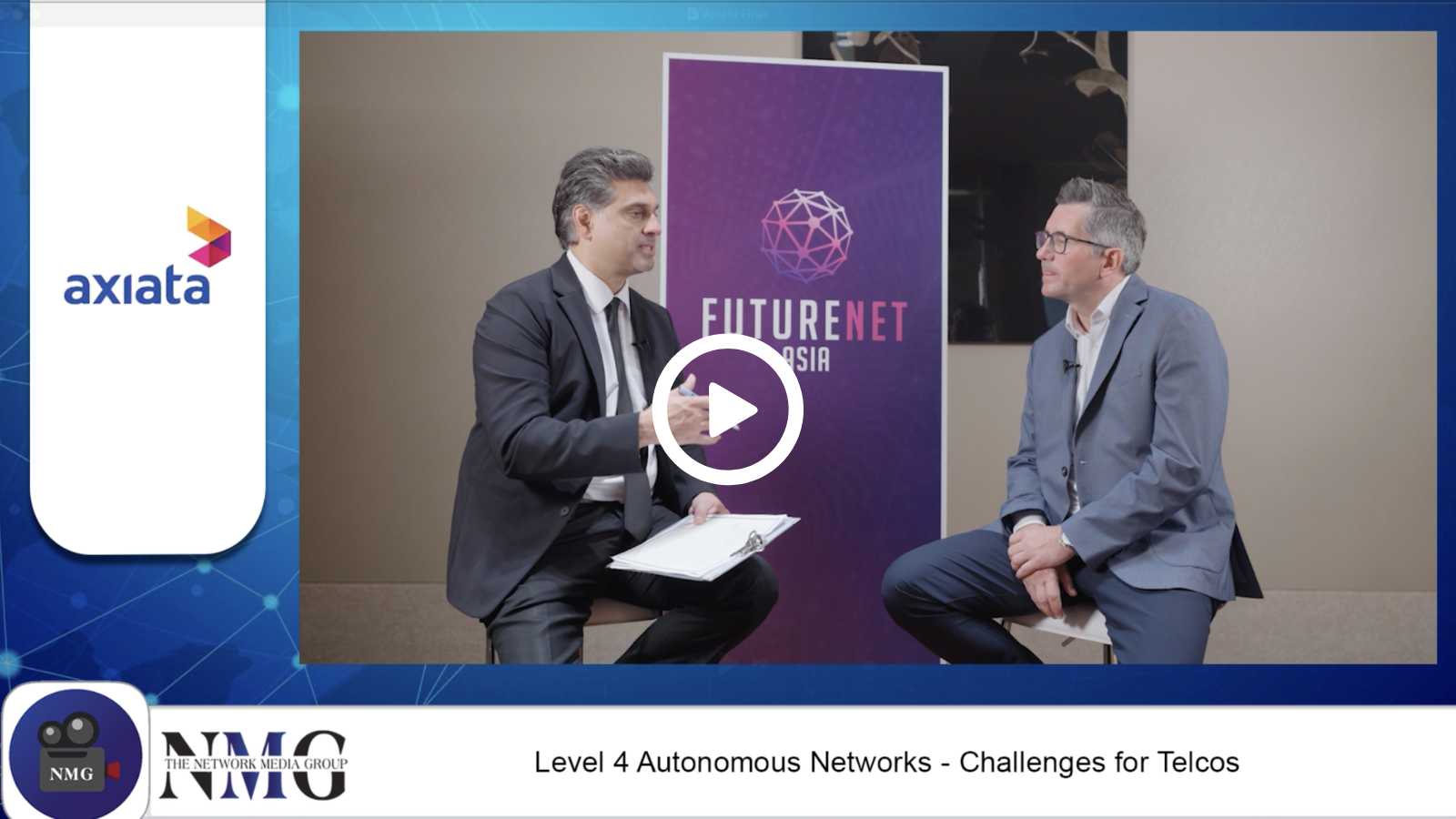
Transcription
ABE: And the session examines how agentic AI is developing for telcos in the telco ecosystem. Joining us are Tomek Gersberg. He's head of FutureNetworks at Axiata.
And Tomek, thanks for being with us.
TOMEK: Thank you for the invitation.
ABE: Well, thanks for being here. I know you just came off another session here at FutureNet Asia 2026. First, I just wanted to get your general consensus of that session. Did anything come out of it that surprised you?
TOMEK: No. No, definitely not, because we are having the same environment. So when we are doing the same stuff, we must experience the same problems, right?
ABE: I noticed one thing towards the tail end of that session that you talked about, sort of the delta between where we are now and maybe where these level four autonomous networks should be. Someone, or I guess the moderator asked you, what are the challenges there? And you said, well, there's a myriad of challenges, but you said legacy systems was one of those.
TOMEK: It starts with legacy, right? Because our asset is legacy. Now we have a lot of this agentic, I would call it still fashion, but also technological trend.
And our systems are not built to deal with it, right? So the legacy is one of the biggest challenges, how to open it. Because level four could be, to some extent, doable with legacy. But deploying agentic level four at the massive scale on legacy, it's impossible.
ABE: What is the progress with agents, agentic AI and agents actually making decisions right now in the network? Are we ahead of the needle or behind the needle?
TOMEK: No, there are agents that act, right? And many of the vendors can present. Those agents usually are going for the kind of high value scenarios like energy management, something that is bringing direct savings.
We are deploying intent-based optimization. So the isolated use cases, there are them. And it's running, I would say, there is no concern that they will be okay. Especially that we are guarding our network.
And this is maybe not very different to that what the others are doing, but maybe some of the operators are still not doing it. It means deploying controllers, like the domain controllers, before they apply agents. And actually, this was also confirmed in the last TM forum recommendation from June on the agentic deployments.
And we are going this direction. First, get your controllers for the domains like SMO, like the transport controller. And the agents, they can interface with the network only through this layer. So no single agent will touch the element directly, network element directly.
ABE: Another one of the challenges, again, the delta between where we are now and where these level four autonomous networks should be, that was mentioned by another one of the speakers on that session, was data and sort of managing that data. Of course, telcos, just by virtue of being around for so many years and having really a deep infrastructure, has ownership of a lot of that data. But managing it and sort of making it intelligent is a bigger challenge.
TOMEK: Look, historically, the data is supporting the process. And the data sits within the application that very often owns the data.
So these are two challenges that, of course, we can automate in the way that we'll be doing faster than what we've been always doing. But if you want to add the intelligence, we also need to change the way how we are doing things. That's why the data is important, that you need to expose all the data in the way that AI will understand.
And there are two gaps. The first is just to bring the data into one place, into one governable sphere. The second is to make sure that the AI will understand it.
It means that AI will be able to find the links between the data domains. And those links are simply missing. The timestamp on the travel ticket is not the same as the timestamp of the event that probably has caused this travel ticket.
So you need to correlate the data in time, customer. It must be always the same customer ID. It must be always the identification of the place, because the events happen in space.
And in the network context, which means the topology of the moment and the configuration of the moment. So we don't keep this data because we never needed that. But now if we want to need the intelligence, we need to also put more data to build this intelligence.
ABE: There have been some challenges in the past with telcos being such large entities and having trouble in challenges, moving technology at a brisk pace, as some of the smaller, more nimble companies can do out there. Open RAN was one of those challenges where it may have not moved or did not move at a pace that people expected, maybe. Do you see AI or Genting AI moving at the same pace?
TOMEK: But first, I need to address this. The best example is that we are, as the legacy operator, deploying SMO. SMO is a part of ORAN architecture. It came from ORAN.
So maybe you know ORAN is advancing, but not from the power side, but from the management and intelligence side. And this is good for the AI. For Agentic parts, it's more difficult right now because you need to have the management for the agents, a management layer.
Right now, the agent orchestrators that are mostly available, like with the hyperscalers, tool sets, and so on, they're doing very simple stuff, which is related to the inventory of the agents, of their capabilities, like recording the actions, doing this simple governance, scheduling, and so on. For the Telco, we'll be needing much more. Especially everything that is related to the conflict resolution between the agents, because very soon they will run into conflicts on every level.
On the business conflict, because the business conflicts are already built in our business, on the service conflicts, and on the network conflicts. This is the part that is difficult and needs to be addressed. The first attempts, what I see right now, is more about conflict avoidance than resolution.
So conflict avoidance in the way that you give the priorities to the agents. So one agent is more important than the other, so he takes the way. But now building the systems that are optimized requires a different type of conflict resolution and negotiations between the agents.
ABE: So for Telcos to take advantage of AI, agentic AI, and everything under that umbrella going forward, would partnerships with companies that are more nimble be something of value for Telcos to really take advantage of this time?
TOMEK: Definitely, because it's a new ecosystem. The impulses for the new ecosystem are not coming from the incumbent vendors. It's a general rule of every business.
You just act slow to protect your business and also to look where the technology will go, not to bet on wrong choices. So openness of this ecosystem is the key. And in our architecture, we open this ecosystem through the architectural design itself to be inclusive.
You know, like SMO opens us to our apps of every small developer, so we can deploy intelligence, which is coming from every place, not only from two or three vendors. And the openness also, you know, and democratization of the data. Because right now, very often, you know, the application is sitting on the data, is owning the data. So democratizing the access to the data is also a key.
ABE: So on a scale of one to ten, ten being the best, do you feel at what level are telcos moving toward the genetic AI in your opinion right now? And how can we improve that maybe?
TOMEK: I can't tell. I can't tell because it's moving so fast.
You know, the people have also various telcos have a little bit of various or different focuses. So I can't tell. But if I would judge on the maturity by availability of the tools the telco can buy, then the maturity is very low.
Because most of the things that I could, that I require right now, I can't buy.
ABE: Yeah. Interesting.
You mentioned that in a previous session as well, and there were a couple of major suppliers sitting right next to me and they sort of smiled when you mentioned that. True, and they weren't disagreeing, but it was just...
TOMEK: It's a hard job for them as well, right?
ABE: Yes, it is. It's a challenge.
TOMEK: They have also their own legacy. So how to transform it wisely, it's not an easy thing. I would not blame any of the big vendors. They've been doing for years a great job. And I trust they will get this.
ABE: Yeah, absolutely. No, it's a true statement. So if we were sitting here this time next year talking about a genetic AI and sort of the evolution of that, where would you like that conversation to be? Let's say in an ideal world.
TOMEK: In the ideal world, I would like to talk about the challenge is how to manage the intents and especially how to resolve the conflicts between the intents.
So just assuming that we already know how to deploy the agents, how to make them smart, but now how to create a smart system out of the smart agents. That would be the challenge.
ABE: In full transparency, do you feel like that's something that would be a viable discussion in a year? Or are we talking about a couple... I know there's no crystal ball, but...
TOMEK: Because sometimes this is a kind of time of disruption, right? Two years ago, we were not talking about the agents at all.
Although we know that this technology is coming. But we didn't know that it will become a kind of main wave now. So it's difficult to say, but with all the money that is now coming into this AI business, I believe that some of the money will pay off.
And there will be a product that will also transform the way how we build the networks of agentic AI.
ABE: So you would say a company like Axiata would be more open to the smaller players out there presenting solutions to these challenges.
TOMEK: We are inclusive.
ABE: Yeah.
TOMEK: You know, you can be big, you can be small. The most important thing is you deliver the value. Because for the companies like Axiata, that we are operating on the low RPM markets, we need to be efficient in the P&L way, right? Everything that we do needs to pay off, right? So we are not doing it because a new technology is coming. We are doing it because we see the chance for the business case. We see the chance to improve the efficiency of the CapEx, to reduce OpEx, and also to leave the revenue.
This is the ultimate goal, right?
ABE: Yeah. Very interesting. Well, it leaves a lot of runway for people like us to ask you questions.
Very exciting time. We've said a very exciting time before, but this really truly is a very exciting time. So we appreciate the time and the insight.
And I'm glad I had a chance to listen to your previous session. It was very insightful. So hopefully we'll have a discussion similar to this in a more progressive way either this time next year or sooner.
TOMEK: I hope too.
ABE: Maybe a TM forum next June.
TOMEK: That would be awesome.
ABE: All right. Talk to you soon.
TOMEK: Thank you.
Sign up for Daily CommTech Brief here.
For any inquiries, please email anejad@thenetworkmediagroup.com