
AI & Cloud Native Networks: Indoor Wireless
Transcription
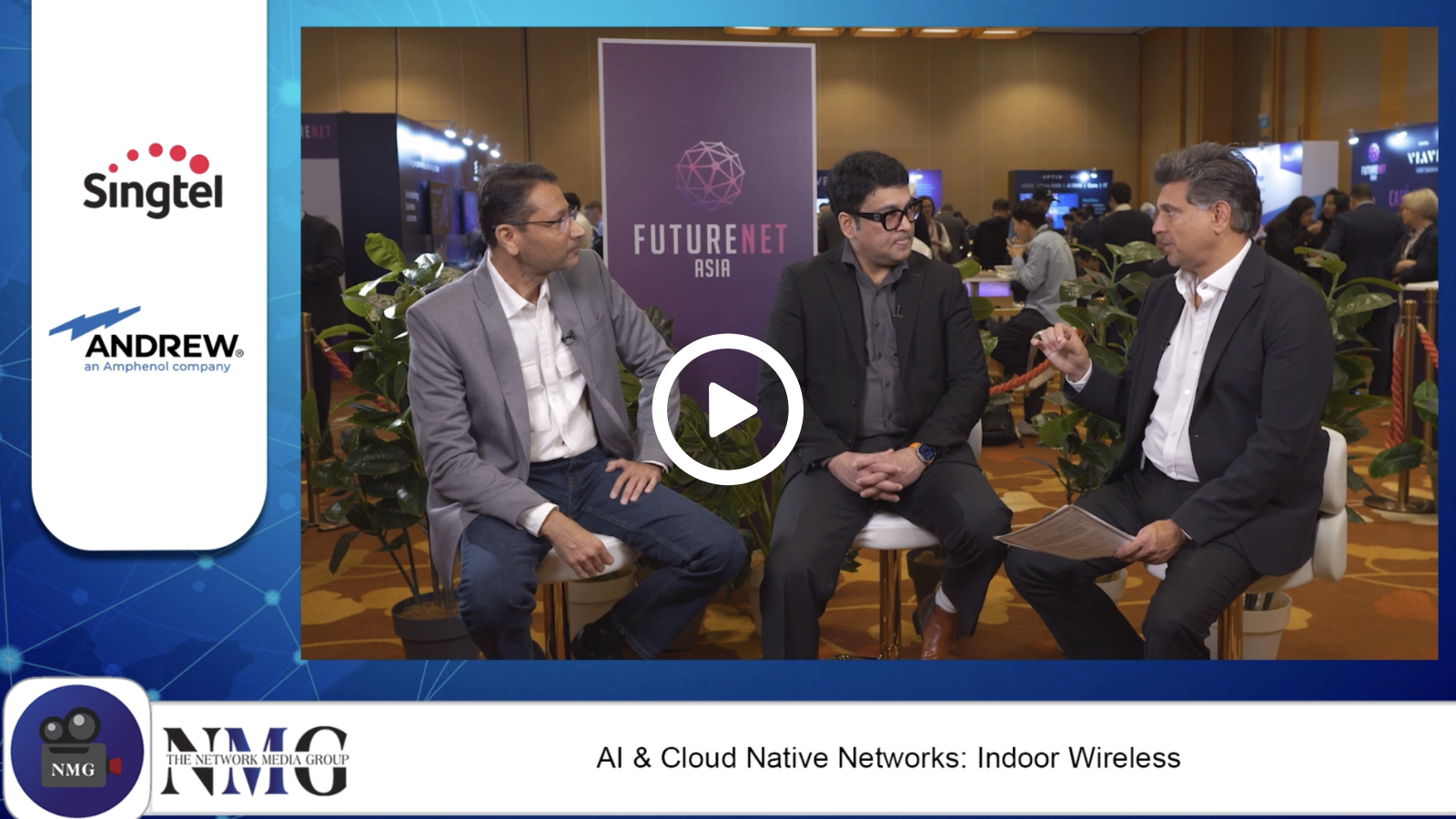
ABE: And this panel will explore what it will take to build an end-to-end digital foundation that connects cloud and enterprise applications with the network and the physical environment where connectivity is increasingly critical. Joining us are Vinod Joseph, he's Group Vice President, AI, Data, Cloud and Enterprise Architecture, that at the Singtel Group. And next to Vinod is Upendra Pingal, he's General Manager, Intelligent Cellular Networks at Andrew and that's an Amphenol company.
And gentlemen, welcome.
VINOD: Thank you, Ed. Thanks for having me.
ABE: Thanks for being here, Upendra. Thanks for being here as well. Of course, we're here at FutureNet Asia 2026, always a lot of runway of topics to talk about.
So, title of today's topic is Cloud Native Networks and the AI Era. Vinod, I'm going to start with you, if you don't mind. As AI sort of permeates these enterprise and telecom operations and networks, what does the cloud and network architecture really need to look like at this point in order to support these AI workloads?
VINOD: Yeah, that's a great question.
I think the cloud is the foundation for building AI infrastructure. It is the platform where you're actually building your AI assets, toolkits, including your GPU infrastructure and so on and so forth. So, I think the first primitive is try and build it cloud native.
And what I mean by that is you have applications today that can run on-prem in a sovereign manner. Tomorrow, it can run on another infrastructure or another data center. And you want to have these application mobility to be as agile as you can.
You don't want to really have a huge monolith type of an application. So, cloud native principles are extremely important. And I think we need to kind of push forward in that direction.
The network is extremely important. And I think today we talk about or the sessions we're talking about AI for networks and networks for AI. I'll start with networks for AI.
The new generation of networks, you know, there are two contenders. One is Ultra Ethernet. The other is, you know, obviously InfiniBand to power up a lot of these GPU clusters and infrastructure with the lowest possible latency.
So, I think latency is extremely critical. You need low latency. You also need to have networks end-to-end that are extremely agile and programmable.
Because today's AI workloads are not sitting within our data center. They're actually going all across to a subscriber's mobile phone or a handheld device. And that's going across your RAN, your core and, you know, a whole bunch of infrastructure.
So, you need to make sure that this infrastructure is as elastic as possible and programmable. And I say programmable because today you can have a different class of service that is offered to a subscriber. How can I actually turn on a premium service for a particular workload? Whether it's a handheld device, whether it's a factory, or whether it's a workload that needs utmost priority.
So, these networks need to be completely fungible, programmable, and elastic. That's the networks for AI. AI for networks, again, becomes important because how do you actually perform root cause analysis in these networks? How do you check for performance? How do you autonomously re-engineer, re-optimize, and heal these high-velocity networks? So, that's where AI also comes and plays a key role.
So, I kind of look at cloud, network, and AI sort of intersecting at a very, very crucial juncture to actually make this whole thing work well.
ABE: Upendra, if you know, it's set the stage quite well. Let's kind of segue a little bit into enterprise indoor networks. And what we really need to do at this point to stabilize and increase the value around performance, scalability, and flexibility. And how Open RAN and really VRAN play a big part in that. Again, sort of setting the stage for the discussion.
UPENDRA: So, first off, when we start thinking about enterprises, there are two aspects we can look at it. One is the Wi-Fi-like simplicity. Wi-Fi-like ease of use. But, the authenticity, and the security, and the low latency that comes with the cellular network. Things that we just heard. So, how do you make sure that you provide that value to the enterprises? That kind of combines the simplicity as well as the security.
I think security is getting more and more important. So, if you think about Open RAN architecture, if you think about a Cloud RAN, a VRAN type of architecture, how do you make sure that the technology actually gives you those things that enterprise needs? So, with Open RAN, you can get the best of whatever you can get from a CU, from a DU, from an RU. And to be able to give you all those AI-enabled networks, you want to pick the best of the best OEMs who can give you that particular piece of the puzzle.
With VRAN, the enterprises like the simplicity of cost servers, for example, you want to be able to take the loads and put them in the Cloud. So, between VRAN, and Open RAN, and AI-RAN, I think we can provide that architecture that allows the enterprises to do what they are able to do.
ABE: Vinod, back to you, as we're applying AI to really these campuses, factories, and other venues, can you give us an example of how the network architecture, the Cloud architecture needs to change in order to support that? Is there some specific example you might be able to share with us?
VINOD: Yeah, absolutely. I mean, if you look at physical AI, or even V2X, you know, these are very critical workloads, or very critical AI applications. We really want to ensure that the best quality of service is available to these particular applications. So, you've got to look at how you build these networks that are completely resilient, programmable, and also how can you actually manage them at scale when you have infrastructure that is, you know, moving and handling billions of different objects, you know, IoT, and so on and so forth.
So, network infrastructure definitely becomes very important. But what I'll also highlight is, it's a balance between what kind of an infrastructure you want to build locally, at the edges, on-prem, as well as what are the workloads that would use the Cloud, or the central data center for analytics. And this is an emerging trend where you're seeing models that are smaller in nature, that can run on a handheld device, or even on your laptop, or even at the factory edge, do a whole bunch of processing, behave autonomous, and only periodically, when needed, push data back into the Cloud, right? Or your central data center.
So, we're seeing the emergence of a different model of AI applications that are going to be built and deployed. Because I don't think today's AI, especially physical AI or V2X, can completely rely on the Cloud to actually make critical decisions. Because, you know, you're going to have networks at some point in time which may be a little overloaded, or which may have some delays, so local processing is also becoming important.
And I think one thing we need to realize is that models that are billions of parameters, or even trillions of parameters, are not the answer to everything. So, a lot of this innovation is moving to the edge. So, you need to have the environment-specific variables taken into account when you build infrastructure, either for the edge data centers, the remote data centers, or even, you know, handheld, on-vehicle sort of infrastructure.
So, I think this is kind of really a space we need to watch out for.
ABE: Upendra, when you bring in Cloud Native and Open RAN and those factors into indoor wireless networks, what are sort of the top-line key challenges that you're facing, and how quickly are those challenges changing?
UPENDRA: No, everything that we just heard, I think challenges, there are a couple of challenges that come to mind. And we've got to, as an industry, address those, to be able to implement all these functions that we talked about.
One is integration. Yes, it's great to have different suppliers providing you the best of all the puzzles, and you get the features, but how do we make sure that we integrate them in a way that the features and the releases happen at the same time? You know, everybody has a different way of implementation. For example, if you think about Open RAN, there is a standard for Open RAN, but the implementation can be different by the OEM. So one thing is, how do you make sure that the implementation and the timing of the release is in line with what the operator is looking for? Number one.
Number two, I think the ownership and accountability of the entire RAN. If you have different people providing you different equipment, you still want somebody to own that whole thing, right? Because at the end of the day, our job is to make sure that the sinker is happy, for example.
We want to make sure that we are providing them RAN, that they feel secure, right? Authenticity and security is becoming more and more important. I mean, you know, you just talked about sovereignty of the network. Open architecture inherently is going to have different suppliers in it.
So we've got to make sure that the accountability matrix is very clearly defined so that we can provide the overall RAN package that you feel secure in.
ABE: You know, I want to look a little bit into the looking glass here. If we were sitting here this time next year, talking about how AI will really dramatically change what indoor wireless networks and other networks as well, cloud networks, how it will make those dramatic changes. And I know this is kind of a front-loaded question, but what do you think, what would you like the discussion to be about a year from now or even two years from now?
VINOD: Yeah, I think we've been talking about self-healing networks and we're talking about resilient networks for a very long time now. But I think the problem has always been the industry coming together and building an open and interoperable architecture, whether it's network, whether it's compute, whether it's storage, whatnot, right? So I think with AI, the game is changing. Everybody wants to reach a point where there's real value that you see from AI and that comes through not just proactive management, but also autonomous operations, reactive, you know, something that can be a blend between, hey, I anticipate this to happen and hence I want to make this change.
A high degree of intelligence combined with autonomous behavior. We're just moving there very fast. I mean, right now you can see the industry talking about building safeguards and other secure primitives around it.
Hopefully all that happens and then you're going to have the ability to drive value truly from AI in actually healing and making real changes to critical choke points in the network, if you may. And when you come to that, I think it's going to be how exactly are you going to balance this intelligence without getting yourself locked in to a particular provider, be it model, be it infrastructure, be it cloud, be it network. How do you really balance that? From an enterprise, I think that's where the real value is going to come where the industry is going to converge on saying this is exactly what we want to provide for you to actually enable a plug-in, plug-off architecture.
So my advice or what I would like to see next year is kind of moving to a stage where working and integrating AI at large, at scale, has very well-defined standards and the industry adopts it. I think we've seen a lot of mistakes in the past, be it with networks, be it with other areas. We can't repeat that with AI. Otherwise, we're going to create these snowflakes and highly specialized complex operational environments which are going to be very hard to operate rather than seeing value.
ABE: Yeah. Somewhat the same question. Sitting here, let's say 18 months from now. And again, front-loaded question, but do your best. AI-native enterprise architectures, what will that look like 12 to 18 months from now?
UPENDRA: So I'll draw a parallel just to make a point that if you think about software-led, AI-led software development, what you do is you start with the requirements first.
Then you go develop the code. Then you go test the code. Then you iterate that.
Then you go implement that. Then you release it. And then you operate it.
Apply the same logic now. Start with the application. Start with the outcome.
I think the days of let's go build the network and they'll come are gone. You have to start from an application point of view, use case point of view, and then work backwards. When you start working backwards, I think the three pillars of the whole brand deployment, development, deployment, and management or operation of it have to be factored in at the same time because traditionally we have seen like three separate teams operating them and they were like siloed.
But if you start thinking about where the future is going, these three pillars of the network in terms of development, deployment, and operation have to be combined. They have to be managed by the same AI infrastructure and that's how we can provide a network to the likes of Singtel and have an efficient network on hand. And again, end of the day, you can have the cheapest network, the best performing network, but if it's not secure enough, it doesn't matter.
So at the end of it, on the top of it, security has to be the key.
ABE: Should definitely be part of the conversation. I feel like the security aspect and also the standardization and really the adoption of those standards are two areas that really need to be talked about more and maybe on a next session with both of you, whether it's a year from now or whenever, we can touch on that a little bit more.
Upender Pingle with Andrew and Amphenol Company, we appreciate your time and your insight as well.
UPENDRA: Thank you.
ABE: And Vino Joseph, as always, we had an opportunity to speak to you this time last year, so we really appreciate your time and your insight as well.
VINOD: Always a pleasure, Abe.
ABE: Thanks so much.
VINOD: Thank you.
ABE: Thanks so much.
Sign up for Daily CommTech Brief here.
For any inquiries, please email anejad@thenetworkmediagroup.com