
Keynote Panel: The Telco Reinvention: How can AI fuel Value Creation?
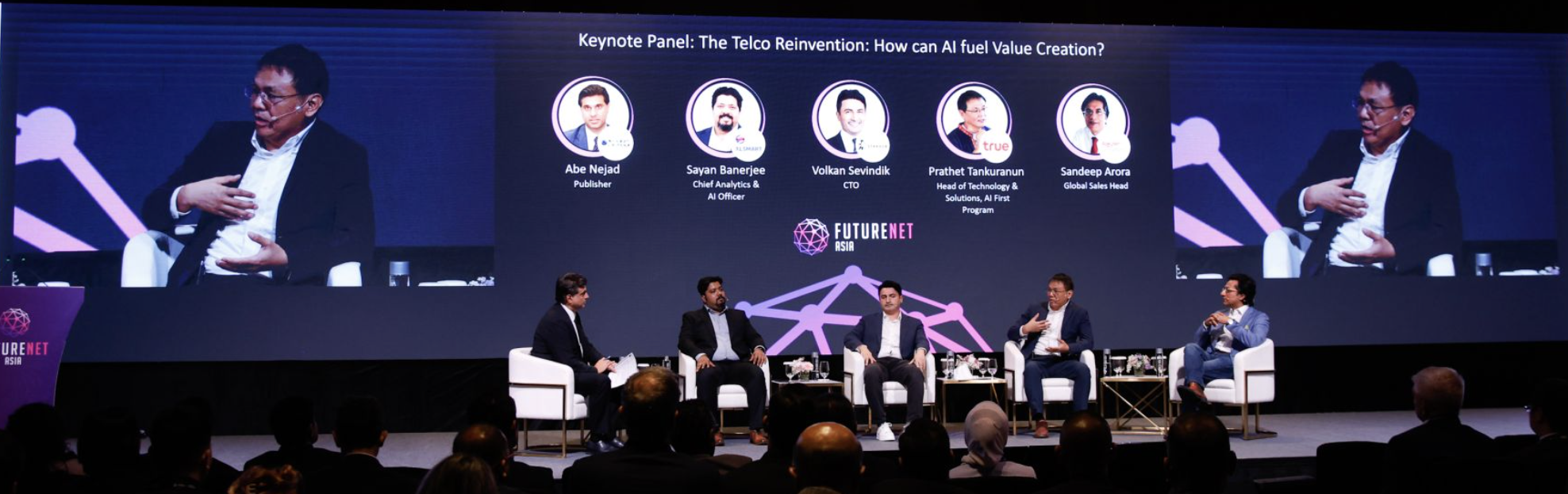
Transcription
ABE: So title of today's session is the telco reinvention, how can AI fuel value creation? This is not a topic that neither one of us has not talked about at nausea, maybe, and especially over the last year or so. So I wanna take a bit of a different angle on this discussion to provide a bit of value there. Prathet, I wanna start with you, if that's okay.
From True Corporations' perspective, we've all been talking about moving the needle for telcos as far as moving beyond connectivity. With the AI or the advent of AI, it's giving telcos a real chance to move that needle and sort of get ahead of the technology. What has to happen from your perspective in order for telcos to be successful with the AI advent as opposed to maybe some previous efforts that didn't really materialize in a timely way?
PRATHET: Yeah, thank you.
I, when I hear this kind of question, right, people are, the first thing that people could think of is that what would be, you know, something that would come in and generate revenue, yeah? Or cutting costs. I think what we're looking at is that maybe like some applications that would come in and help boosting revenue, but I myself, I see this in the two different aspects. Number one is that we would, what is the way that we could use AI to help improve our operations, so that is one thing.
Another thing is that how could we play a part in the AI ecosystems, right? So what I'm saying is that the, what we're doing is that the improving operation, all of this automation that we're, all of us are doing. Maybe we do, you know, some tickets, you know, network operation, everything. We do some customer cares, we do some marketing.
That is one part of it. The other part of it is that how could we become a part of the ecosystems, right? All of us, we're operators, you know, most of us are operators, maybe some suppliers, some partners in here, so we've been selling connectivity. We've been selling connectivities, we're selling minutes, we're selling bytes, but what we do not realize that we are the gateway to the customers to connect to the world that AI lives.
AI lives in internet, AI lives in the data world. We are the one that holds the key to connection from our customers to this AI stuff that is in the cloud somewhere, right? So that is the value that we have. That is, I believe it is more of the source of revenue or opportunities, put it this way, rather than just, you know, try to talk about efficiencies here and there, or maybe some, some of the use cases that we're thinking of.
That is my thinking.
ABE: Yeah. Volkan, I wanted to go to you again.
By the way, congratulations on your daughter. You just had a daughter. Thank you, thank you.
I see you sweating over there. I'm not sure if that's from the... So same question. What needs to happen for telcos to take full advantage of this advent of AI? And if you could just give me maybe a contrast between that and maybe what's happened in the past, even with OpenRAM.
VOLKAN: So what we use AI is more like creating a foundational layer in terms of operations, first of all. And so right now we have systems in place to detect per subscriber, per service performance metrics, right? So that's the first thing we are doing with AI. For enterprise customers, we are not selling bandwidth, we are selling outcome.
And that outcome is usually, like, if you talk about the finance sector and healthcare sector, what they ask from us is really these certain network slices in terms of security and latency. So this is what we provide to them. And we use AI to package the service for them.
That's the first thing. Second thing, I would like to talk a little bit about cybersecurity. So Singapore, I came here almost one and a half years ago, and it's still so hot for me.
Yeah. And the CAI level of security mandate in Singapore has put us at the operational level that none of the enterprises can replicate. Because it's too costly, it's operational heavy, and also there is so much underlying infrastructure investment that you have to make to secure your systems.
The enterprises we work, there are 300,000 SMEs in Singapore. Many of them, they don't have financial capability to provide that kind of security. So what we have done, use AI package this and secure slices for them.
But that's the second aspect. And third aspect is, really, we created all this API platform for enterprises to consume. Today, for instance, we are working with one of the biggest banks in Singapore to provide SIM swap prevention, provide location of subscribers in real time.
Also, number of verified services where they can check your number if you are the one withdrawing the money from the ATM. So we have all these platforms ready and being consumed by enterprises in customer and across the region today. So this is how we are using automation and AI to scale it up and make it ready to be consumed by the enterprises.
ABE: Sayan, somewhat of the same question, moving towards new revenue streams rather than talking about reducing costs.
SAYAN: So I think this was for the last seven, eight, 10 years, we have been always focused on cost. How do you minimize cost? How do you minimize or improve customer experience? I think these are the two levers primarily where Telco was focused on.
But as soon as the generative AI came in and with advent of the agentic solutions, I think there's a huge focus towards moving away from the only cost-based system to more value-based transactions. One of the points which Bharat talked about was around we have been the pipe all across. We have been giving data.
Previously, we used to give minutes. Now, we give data. But we have never been able to capture the whole end-to-end journey in terms of making value at the end of the spectrum.
I think this is one of the opportunities which we have at this point in time and probably for all the Telcos globally, that this is probably one of the Netflix moments when we could not become the value orchestrator of content, but we can become the value orchestrator for AI products. So I will probably break it into three parts. One is primarily personalization, knowing the customer more.
So wherever we are using AI primarily is to understand who the customer is, knowing more about the customer. The second part is primarily around enhancing customer experience. And when I say customer experience, previously, we always saw that the customer experience was a chatbot which will solve your FAQ questions.
But today, it is no more a chatbot. It solves problems. It takes actions.
And the third primarily is on the AI as a product where the customers are willing to pay for that. So because we are the pipe and we already connect so many customers, we have the identity. We know who the customers are.
We know their billing systems. We have the last mile distribution advantage. So why can't we be the part of delivering AI production solutions which the customers are willing to pay for?
ABE: Sandeep, over on the end there. Moving from operational efficiencies to now monetizing this intelligent network, what's the journey there for Rakuten Symphony?
SANDEEP: Firstly, thanks, Abe. It's always a pleasure to be with you.
Thank you, team. I think, let me just put a thought-provoking point out there and then I'll give you the context from where Rakuten and Rakuten Symphony comes from. Number one, we have seen over the last three decades four key foundations from internet to mobile internet to cloud, now to AI.
And we still seriously, passionately talk about connectivity. I know that's foundation, but that's important. But our approach has been a little different, to be honest.
And that Rakuten approach has been different because the way we came across for the last three decades, we were an ecosystem company in e-commerce, in fintech, in content management, in lifestyle services. So we built the ecosystem and then we came about in a mobile network and providing these assets to mobile. So our approach is about the ecosystem first and then about connectivity.
The main point for us jumping into mobile and assets is primarily more than connectivity, it's data. And as we say, an AI agent can be very clever but would be blind if we don't have the context of data behind it. So where we look at it is that we are building an ecosystem platform.
Can we build a network as a platform for ecosystem? And that's the way our approach is. The expectation is that while we drive inherently cloud native architecture, which is easy for us, we don't have to retrofit AI into it because it's already programmable and we can open up the APIs and build MCPs, standardized MCPs over it so that the AI agents can natively and naturally program the network the way it is as providing ecosystem over it, the services over it. You're as good, your network is as good as where we look at monetizing it than in terms of cutting it.
The last thing I'll just say in this is that while automation for us drove the cost down for running a network, for us autonomous network helps to bring the cost down for changing the network. And that's very critical for us, how we drive autonomous network because at the end of the day, what customer's looking for is an outcome. I think we could talk about it.
And that's what, they don't care about networks, slides, dynamic connectivity, they want outcome. And our AI agents have the data, the context to provide those outcomes and the ecosystem platform which we are looking at. So we are coming from a business to network and from network to business.
ABE: Perthet, that's a good segue into the next question I wanted to ask you as we move from these operational efficiencies discussions and also the real world journeys that you're having at True Corporation and now to these new revenue streams, what use cases are you seeing that are gonna really get traction first?
PRATHET: Yeah, I think it'd be wrong if we think about, if we would think that there will be one particular use case that would be the Holy Grail of the applications. AI has many capabilities, it does, it could do many things, right? For us to think about, oh, what is that one particular use case where everyone implements and suddenly we all get rich, that would be a wrong thinking. In my view, AI would come in, first of all, right, the operation efficiencies or improving our own internal operation.
We are doing this alarm correlation, a network automation, maybe using AI agent to now manage a network, that'll bring some efficiencies. Everyone is doing the AI on the customer care, customer services part, they'll be bringing in some efficiencies, they'll be bringing in some customer experience. We are using the AI for internal work, back office works, finance, accounting and everything, they'll be bringing in some efficiencies as well.
And the other part is that this is something that we operators, we tend to forget that we are here on the ground, we own the land. So another source of revenue, are the AI hyperscalers, they live somewhere in the cloud, we are here. They cannot exist without us.
So another source of revenue, guys, we have fiber connectivities, we have sales sites, we have data centers, we have all of these connections that are happening here, which is the bloodlines, which is the nexus connecting all of these brains or whatever models that are out there. This is the part where I see as another potential source of revenue. I think a lot of operators around the world are seeing the same thing.
SyncTel here is doing something, iOS, they are doing something, ExcelSmart, I think thinking about it. So that is another part where I leave it to the audience that think about it, that would be my take.
ABE: Yeah, Vulcan, I wanted to ask again from Starhub's perspective, moving from these operational efficiencies that we've been discussing for quite some time to these new revenue streams.
First off, from Starhub's experience, what's that journey like? But secondly, is that moving at a pace that you're comfortable with? And what can we do to expedite that?
VOLKAN: So let me start with the services and the services we are selling today, right? So we have very close relationship with enterprises in Singapore across the region. So we have customers in Malaysia and other countries around. So they always ask us, but we are working with hyperscalers, what does Starhub bring to the table, right? Our proposal is this.
So we have huge network operations center and security operations center. So we provide many services and manage operations, first of all. Second of all, our network is programmable.
Any enterprise customer today can create their own version of Starhub network depending on latency and throughput and speed. Now we added third dimension, which is cybersecurity. There is a huge demand to create VIP slices from CAI-based industries, like healthcare and finance.
So we have huge customer base from finance and wealth management. Also right now we provide sovereign and AI and data. All these customers, they want their data not leaving the country.
Also they are asking for solutions where again, Starhub can provide at scale data masking. Can we mask the PAI information at scale in real time so that they can train their own models, right? I am sourcing petabytes of data every day. So if you are just looking from connectivity perspective, it's 10%.
90% is the skills you build internally, right? Now I have a team which can label the data in real time, which is in the order of petabytes every day in 24 hours. No one has done this in this world. Even big financial organizations like Bank of America, they are not reaching to that skill.
So there's a different skill that you bring to table. And also AI inference capabilities, not leaving the country. How can you keep the data in the country at the same time provide data from far? We have subsea cables connecting the whole region and subsea cables are owned by Starhub 100% and we have full observability in the subsea cable.
So also we combine, actually we create end-to-end value chain, not just connectivity. That's the first thing. The second part also we receive a lot of questions in terms of trust.
I would like to talk about trust because previous session, one of the speakers asked, like what else can we bring to table as telecom providers, right? We have to bring value. We have to make revenue from this AI storm.
First thing is trust. As you know, telecom operators, we have been rolling out SIMs almost 30, 35 years now. Rolling out SIMs means that a service provider can manage the trusted scale. We are not talking about 100K SIMs. We are talking about 25, 30 million SIM cards, right? Just for people like us, mobile subscribers. Think about the IoT devices. Think about the future.
You are talking about billions of devices asking for eSIMs in real time sometimes. You have to provide provision in real time. So now as a provider, we are natural attestation layer for agenting economy because we can provide, actually, we can verify these agents representing enterprises.
We can verify who that enterprise is and we can also authorize what the agent is allowed to do. In less than five years, we will see a lot of enterprises will be represented by the agents, but do we know the real identity of that agent? Right now, GSMA and other industrial partners are working on solutions which can really provision certain SIM cards or identity drive from a SIM to give unique agents, immutable agents, IDs to those agents. And we are talking about millions if you are asking for a number.
So now, a telecom operator is sitting in the middle, not tapping in this value. So we shouldn't think about connectivity. Also, we provided very skilled trust attestation layer already. We can expand that for agentic economy. This is what we are doing. And we are working with GSMA today also on these solutions.
The third one, what we are selling today to enterprises, for instance, there is one bank working with us. We have integrated with their fraud engine. They are checking SIM swap.
They are checking your location. Also, they verify your ID when you log into your bank account, anywhere in the world. For instance, you just came from New York, right? And now, if you want to withdraw some cash from here, probably you will get notice from your bank.
So that's all enabled through APIs, checking your phone, checking your SIM card so that no one stole your phone and swapped your SIM and claiming that the person is AIP. So with all these different values that we already have, we are using AI to package it. Because even packaging can be done by AI based on consumption.
Sometimes we tell enterprises, you bought this service, you paid for it, but you are not using it. Can we offer you to replace that for something else? So AI can accelerate that packaging and also create different value offerings for different clients in real time because it just became so fast. The consumption became so fast.
Also, customers, they want faster and more trustable service. I will go back to the first point that Singapore's CAI mandate put us in a position that no one can offer today. Because right now, if I provide a service, I have put firewalls around it, I have put access management around it, and I have put certain security layers across several layers, provide the end-to-end security for that client specifically.
So it is not hypothetical, this is being done today, we are selling it today, and there is so much demand, I can see for the trust, how can we make sure that agent is claiming, what agent is claiming is true in terms of identity. So that's the biggest problem we are seeing as an industry today.
ABE: Yeah.Sayan, another good segue, and I think you're the right guy for this question, certainly. AI generating insights for telcos over the last several years, and certainly in the near future, but now AI agents actually making decisions. Where are we on the timeline of that actually working for telcos, and again, what can we do to expedite that?
SA: I think you are bang on.
We have been working on insights primarily, and then from insights, we have actually moved on to a phase, what I call as decisions, right? We have started taking decisions in telcos, it's just not insights anymore, we are, the decisions are embedded within the system, and when I say embedded within the system, think about a churn solution, right? A person, we know that this person is not happy, they want to churn. Previously, we used to know this whole event through only after the person has churned, so it was a regressive understanding. Then we moved in, and we thought that, let's do predictive analytics on this churn, and try to figure out who are the customers, and how we can prevent them even before they churn, and then we came up with an NBA.
I think this part is pretty much on, and when I say NBA, I'm talking about the next best action, and next best resolution about that particular person, about this situation, but as we move towards, the biggest part is, it needs to take action, so it started off with insights, then it went into predictive solutions, and now it is about taking actions. So previously, all throughout, human was in the loop, human was trying to create those insights, and then take actions based on what the machines would propose them, but today, as we are moving towards, is the agent AI solution, as others were talking about, that helps you take actions at the right end, at the right time, and it learns on its own, because of the feedback, and the data which it provides. The biggest differentiator, or I would say the bottleneck, of having this deployed at scale, is your layer of data, and how you see the data, so every company is in a different mess, primarily all the telcos I come from, I've seen they have multiple different data structures, sitting on different silos, it's very, very difficult to understand that what is the single source of truth, but as you move forward, what most of us are doing, or I am doing, at least in my space, is trying to have a uniform view of data, a data product for each of the three areas, for example, customer 360, care 360, network 360, and on top of that, creating a layer of semantics, creating a layer of knowledge, because agents don't understand data if you give them as it is.
It needs to understand the data through the semantics, and through the knowledge layer, through the ontology, which connects each of the data sources together. My view is that the quicker we can move, or create that data foundations proper, right now, I think in most of the cases, in fact, in our space as well, we have data and semantics in one particular part of the business, but not all across, but as we move, we are trying to create that for each of the business sectors which will be responsible for it. The semantics and the knowledge and the ontology is primarily the driving factor for the agents to take action.
So the quicker anybody can do it, the quicker the agents can take action.
ABE: Sandeep, I wanted to go to you, and maybe go down the line here a bit before we wrap. Monetizing the network by leveraging AI for telcos.
Really on a top, sort of high level, if you will, what needs to happen in order to scale that effort from your perspective? Maybe a couple of examples you may be able to give.
SANDEEP: Sure. I think we have all covered a lot of points.
I'm just trying to put them all together and use some first principles on this. One of the biggest assets who we do service provider have, number one is data, which we believe is super important. Number two, I think we can talk about trust, which is very important.
And third is spectrum, if we look at in the larger scheme of the things. Now if these are the biggest assets for us as a service provider, and if we leverage AI over it and want to use that, I think Saeed talked about how he's building a common data platform across, and that's where we have learned over the last few decades of how do we get the DNA of the customer, the data, and what's best to use it, what's required out of it, and how we call it data IQ engine, in fact. And that's the way we build data across multiple silos, put them together, curate it so that it can be intelligent for AI to leverage it.
The second is obviously trust, and that's very critical. I'll just give a business view to it. I know we can give a technical view to it.
For us, it's not, our customers are not, we don't want to call them subscribers, we call them members. Because for us to work, AI to make it not as a platform, but also as a network economy, we need to make those, our customers, a life cycle. Get them services over it, and that's where you'll be able to monetize it.
So converting, using trust, getting customers to build up, become members, is super important for us. And how do we use the services? And the final is obviously spectrum, and AI is being used from a spectrum efficiency. We see it all the time.
That's operational analytics. Coming to where we, you talked, is there a use case to it? Let's put it this way. We have a developer who wants to use the network, and I want to build an application over it.
Now usually what happens is, a software engineer is good in software, but he might not be the best in having understanding of the network very well. Usually, there are very few people, handful of people, who have both the understanding, deep in software development, as well as an understanding of network. If he's trying to build an application over the network, and if we talk to build a network economy, he should just ask the network that I need for my application, this much of resilience, this much of latency, I don't care about what is a rig, what are the schedulers, what's a part of the code, and that helps to build the context into it.
So what we are looking at is, how do we help providing leveraging AI agents who can build this programmable network economy over it, and using what a developer wants in the application. Currently, application uses network as a highway. What we are looking at, applications start programming the network itself in what they want of it, and that's how we are trying to monetize it over it, and take those things to the market.
ABE: Prathet, anything to add as far as scaling this monetization of the network by leveraging AI, from your perspective?
PRATHET: Yeah, I think a few things that I have in my mind, I'd like to leave it to the audience, is that the option of the AI, right? We tend to create the AIs to help us by putting in the automation here and there, AIs coming in as assisting human, right? In order to adopt the AI, to improve our efficiencies in our operation, we need to rethink the entire thing. We, instead of designing the AI to act as human, but we should redesign the entire process to build around the AI. That would be my one thing that I'd like to leave with.
The second thing is that I think we, Telco, play a part in this AI ecosystem, right? By just like what we're saying, AI is up here, we are on the ground, we have connectivities, we have infrastructure, we have all of these assets that are critical parts in the AI ecosystem, so let's not forget about it. Number three, we own the customers. We own the last miles, we own the last connectivity to customers.
That is, in itself, is a value that we could create, we could leverage from. That'd be those few things that I could leave with.
ABE: Volkan, anything to add?
Volkan: Well, we ran out of time.
ABE: I was watching that.*laughs*
VULCAN: Well, with AI, we are very careful. At the same time, we want to use it, but again, all this connectivity trust and also data and scalability has to be offered in a single package, otherwise the picture will be always missing.
But as a Telco provider, internally, externally, the feedback we receive from our customers, they don't want to use AI for the sake of using it. I think you heard this 1,000 times already. They want more control also in advance value proposal before they implement anything in their CI infrastructure.
ABE: Sayan, anything to wrap with?
SAYAN: So the risk of scaling an AI, and if you want to really scale it faster, quicker, then I think governance is one of the key factors which everybody needs to think
So the risk of scaling an AI, and if you want to really scale it faster, quicker, then I think governance is one of the key factors which everybody needs to think about.
ABE: Sayan, with XLSmart, we appreciate your time and being with us. It nice to meet you, by the way.
SAYAN: Thank you
ABE: Volkan, very nice to meet you.
VOLKAN: Thank you.
ABE: I know you’re under a lot with the new addition to the family.
VOLKAN: Thank you so much.
Sign up for Daily CommTech Brief here.
For any inquiries, please email anejad@thenetworkmediagroup.com