
Telcos and Enterprise: AI, Data and Partnerships
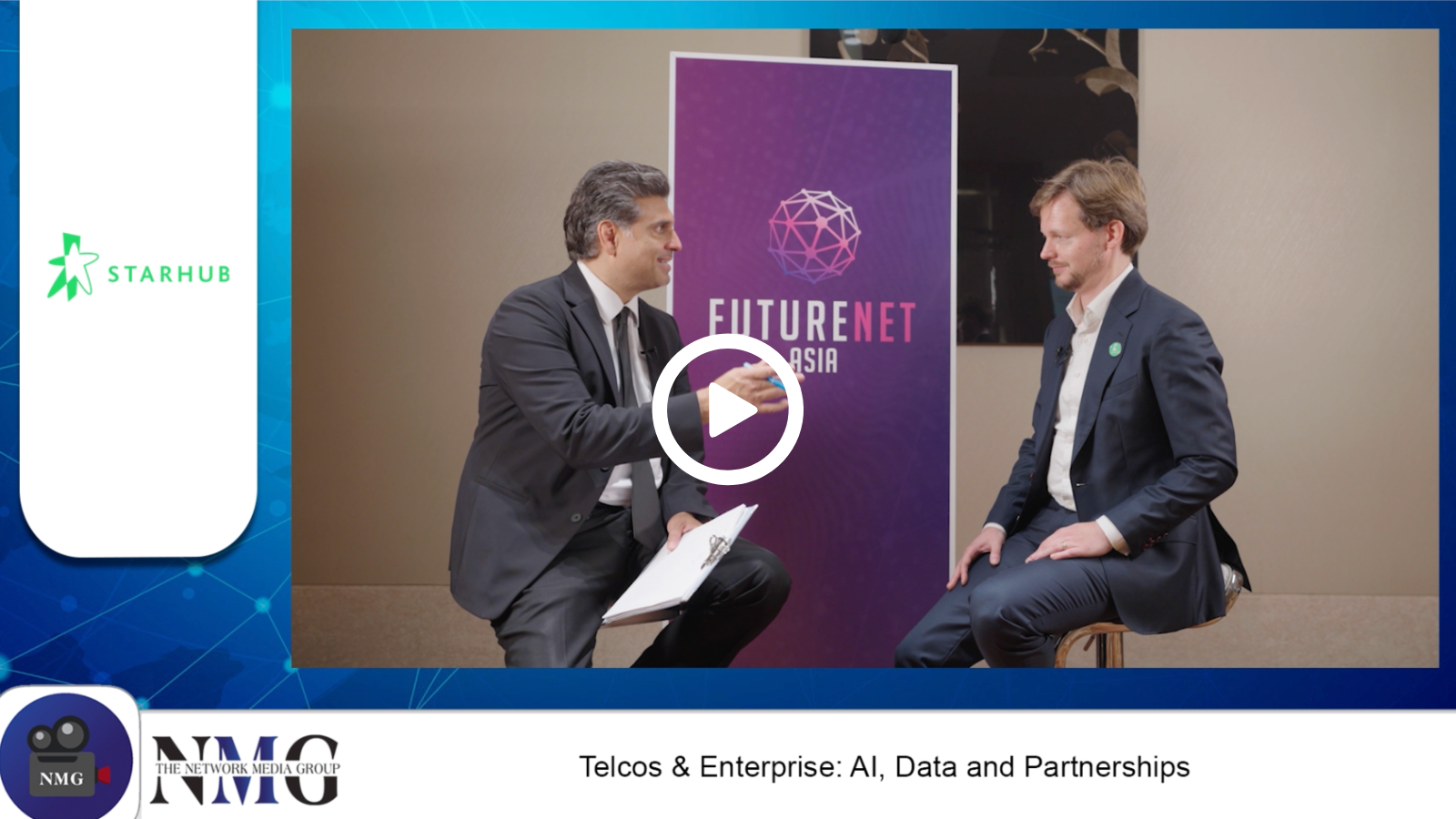
Transcription
ABE: And this session, we'll discuss AI for telcos and enterprises. Joining us is Sander Varar. He's vice president of strategic services that at StarHub.
And Sander, welcome.
SANDER: Thank you.
ABE: Thanks for being here.
SANDER: Nice to be back. Sorry.
ABE: Yeah, absolutely.
We need to work a bit on our timing. Yeah, it's been too long. I know you have a session coming up later in the day at FutureNet Asia.
And so we want to just touch on that a little bit in this discussion, and then I'll certainly sit in on that as well and listen to that as well. So AI monetization for telcos and how that sort of translates into some of your customers, your enterprise customers, and sort of what the day-to-day is on that. I feel like it's just, you know, I hate to say it, death by a thousand cuts, right? You're just dealing with so many problems coming at you at the same time.
It's a little bit different experience than maybe some of the other folks that work for the larger telcos, where they have a bit of a longer timeline and sort of a different framework as far as how they interact with their customers sort of day-to-day. So I wanted to touch on those two or three points. Could you give us a day in the life of Sander Varar as far as what you would experience with a medium, small, or a large enterprise customer?
SANDER: So Starhub is a challenger telco, which means that we are not as well-equipped as other telcos.
So for me as a business executive, it means I spend a lot of time with my team working directly with clients. We're trying to push the envelope on what we do. So we look for problems that are not necessarily well-solved, and we look for clients that want to effectively do things different, because that's what you do as a challenger.
So a lot of my time is actually spent talking about client problems, understanding from a client's perspective what solution they have in mind or what problem they have today, which is not well-addressed, and how we as Starhub can co-innovate and do things with them.
ABE: Give me a little bit of background just for the audience of Starhub, and then your position at Starhub.
SANDER: So Starhub is a telco in Singapore. It's a regional telco, so we do have branches or entities in Malaysia and branches across Asia, but our focus is still predominantly Singapore. We're somewhat unique in a sense that about 50% of our revenue and customer base is from consumer, and the other 50% is from enterprise, with the enterprise bit being growing. So within the enterprise business group, my role is responsibility for what's called end-user services and platforms.
End-user services tends to be everything that a user, enterprise user, or a business user touches on a day-by-day basis, be it hardware, be it telephony services, software, as well as any IT services that come with that. The platforms that my team work on tend to be the larger enterprise platforms, with the biggest one at the moment being our 5G platform.
ABE: So on an enterprise company's speed dial, is the telco number one on that speed dial as opposed to maybe a hyperscaler or smaller technology entity? In other words, how are telcos moving up in the stack as far as the go-to to solve an AI issue?
SANDER: Maybe 10 years ago, your telco would have been top of your speed dial.
Nowadays, telco probably would not even make your speed dial. People, when they think about solving problems, tend to go to hyperscalers or startups. And that's just a reflection of what telcos have become.
Having said that, because of AI, there's a greater need for connectivity to data and bringing things together. And that is also creating an opportunity for telcos to do more.
ABE: So do the enterprises understand that the telcos own the data, or at least they own a lot of the data? And that's a huge advantage.
SANDER: Yes. Increasingly, enterprises do recognize the value of the data that telcos have. For example, a use case that we've been working on in Singapore is around fraud signal detection. So it's about understanding clients' payment behavior and clients' buying behavior. And that's data that telcos over the years have collected and can provide in a reliable and trusted manner.
ABE: So if you could give me an example or a use case of a previous experience or even an active experience where there's an AI-related or agentic AI-related issue or a monetization issue that one of your customers is having.
SANDER: So one platform which we've built over the years is our smart retail platform. It's a platform that helps mall operators and shop operators make decisions on how to run marketing campaigns or how to develop their store network. What it does, it collects and provides data over clients, like prospective customers, that bypass your mall.
If you look at the shop perspective, you usually know who your customers are because you literally have them. You have their data in your CRM where you can just quiz them when they walk in. But what you don't know is that people actually bypass your shop and go to the competitor next door.
So that is the data that we as telcos have and that we can provide. This is something that we've developed as a service and have been providing for a number of years. Where the agentic AI piece came in was in democratizing this data.
In past, when we had to do this, a data scientist would sit down with you and say, like, OK, what are you trying to do? Right. What's your problem? What are you looking for? What we've done is we've effectively replaced the data sciences with an LLM. So that LLM will talk you through a structured questionnaire and say, OK, this is what is actually the data you're looking for.
It will then help you retrieve the data from our data set, pair it with third party data and give you a complimentary, comprehensive view of your prospective clients, which you're not serving today. The thing where it adds even more value is around how you engage and trigger those clients. So the LLM can create campaigns, it can create example imagery, et cetera, that you can give your creative agency or your ad writer or whoever you work with for your marketing in a very specific package content. So you get, OK, this is the audience. This is the audience profile. This is what they would like to do. This is a way to engage them. And then we can also help you track success on that.
ABE: So telcos can provide the data, they can provide the infrastructure, they can provide the consultative interface, the platform even.
In what sense and in what way would you need to partner with another company that's more nimble than the larger telco? And what would be an example of that?
SANDER: OK, so telcos, like any companies, we exist as part of an ecosystem and we don't have all the capabilities to solve every problem on the planet, right? Like no company has. Startups have value because they tend to be very focused around a specific problem area or expertise area. So and this is where things often match.
So an area where we have worked with a startup around AI is video recognition. We had a client who was looking for a video recognition use case. They had a very specific problem, which was related to recognizing goods being shipped.
Because with packaging, we initially approached this from saying like, OK, this is something we can build as a telco, right? We can create this for you. But that is, first of all, complex. And second of all, as telcos, we're not necessarily set up to do that.
So we effectively ended up partnering with a smaller firm that had the technology. But what they did not have was the use case or the ability to operationalize that technology and to deploy that skill. And this is where we as telco added value because we provide the infrastructure, we provide the testing system, managed technology, managed cameras.
So together, we could put together a service package that met the client needs.
ABE: Interesting. I tend to ask this question, if we were sitting here this time next year, I guess a better question is, how quickly does your role at StarHub change under the umbrella and the advent of AI?
SANDER: OK. That's a great question, actually. A large part of my time today goes to workflow redesign. So the services that I tend to have tend to be the more traditional telco services.
So they're established processes, good data sets, established job profiles. And here, we can create a lot of value by embedding AI in the workstream. So part of the work that I'm doing with my team is mapping out the jobs they do today, identifying where AI can replace or add value, and then completely redesigning that job as part of their workstream.
So to answer your question, as a result of that, things next year will look quite different.
ABE: Yeah, that's interesting. In an ideal world, Sander, what could be an advancement by telcos or for telcos to move the needle a little bit faster in sort of the AI race, I guess I would call it? What can telcos do to advance a little bit quicker and be a little more successful than maybe previous efforts on other various technologies that I won't mention?
SANDER: Okay, that's a question I think we're actually grappling with in the room right now.
What we can do different or what we can do more.
ABE: Is it partnerships?
SANDER: So partnerships is part of it, because it's recognizing what capabilities we have and what we don't have. A larger part comes back to being able to structure data together in a standardized and clean way.
As an enterprise, I'd like, for example, in Singapore, there's four telcos. Most markets have multiple telcos. As an enterprise, if I want to create a use case with a telco, I don't want to go around every telco in town and say, like, hey, this is what I want to do.
Can you do this with me? I want the telcos to come back and say, like, okay, this is data that we can provide, or this is APIs that we have and are in a standard, clear manner that I can easily consume. This is an area where, as an industry, we talk a lot, but where we can do more to progress and to make things easier for enterprises to consume.
ABE: So it's not moving at a, I mean, I'm just inferring here, it's not moving at a pace that you're comfortable with or that it should be right now. But it could potentially move at that rate.
SANDER: It's an area that if we, as an industry, work collectively, we could move a lot faster. There's been talk about governance and frameworks today, about how we can standardize certain things in a way to make AI more trustworthy or more easy to govern and manage.
That's an area where, as an industry, we just simply need to do more.
ABE: So data is the new gold. Would that be a fair statement?
SANDER: It's like, without data, AI does not work.
So for us, making our data available in an easy-to-consume, constructed manner, doing it with a standardized governance framework which infers trust, which guarantees you clean data, which guarantees you that privacy and PII requirements are met. For an enterprise, this makes life a lot easier.
ABE: And which primary standards body is associated with the structure of this data? So GSMA, as a standards body, is pushing for this, and the work that they do is good.
SANDER: Don't get me wrong. But as an industry, we could probably come together and move a lot faster.
ABE: Okay. Interesting. Well, Sander, we appreciate the time.
SANDER: Sure.
ABE: Yeah. These are truly exciting times, and it's great to have these conversations. So I appreciate the insight.
SANDER: Thank you.
ABE: Thanks for your time.
SANDER: You're welcome.
Sign up for Daily CommTech Brief here.
For any inquiries, please email anejad@thenetworkmediagroup.com