
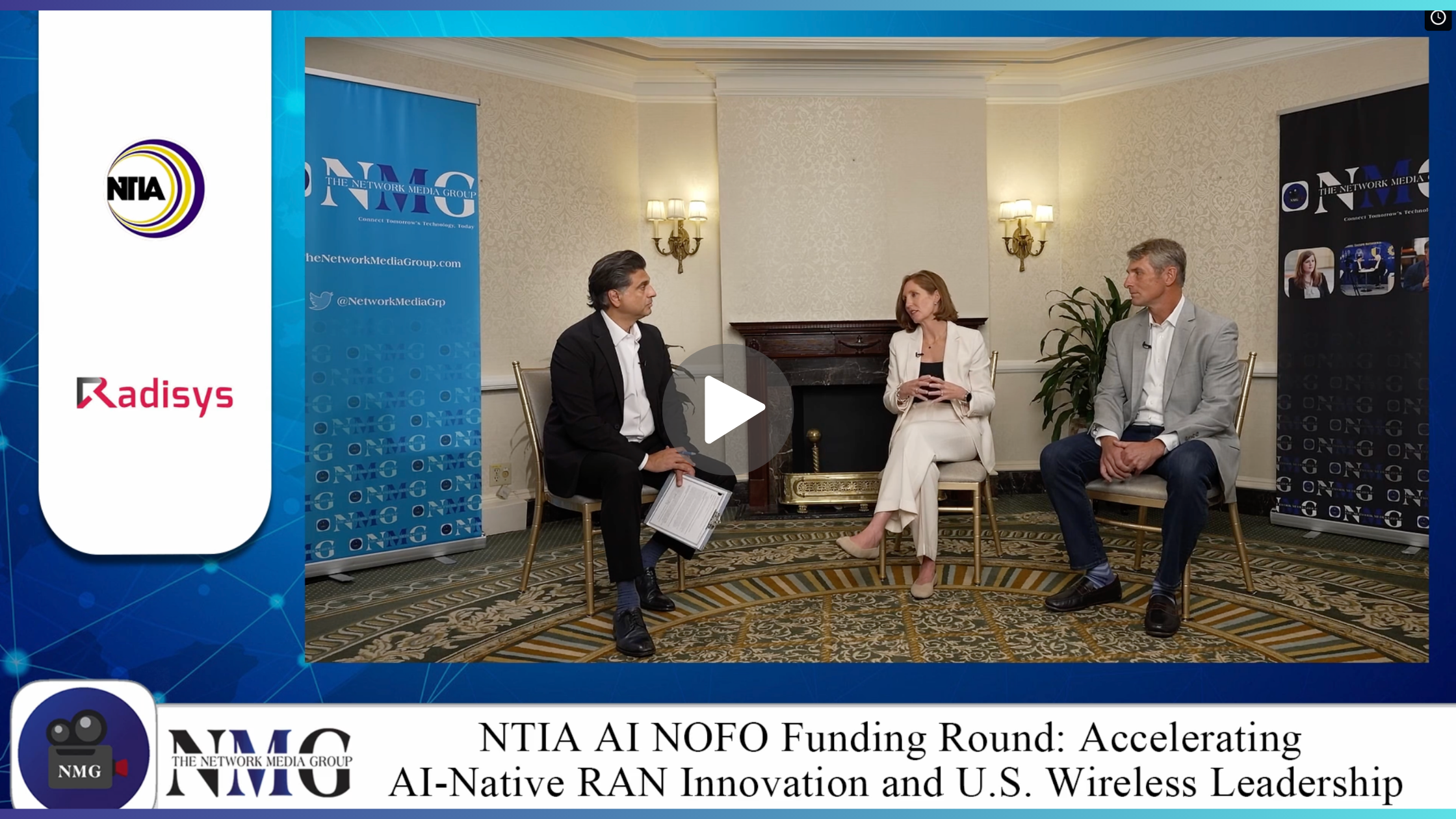
NTIA’s AI NOFO Funding Round: Accelerating AI-Native RAN Innovation and U.S. Wireless Leadership
OBJECTIVE:
As the National Telecommunications and Information Administration (NTIA) prepares the next phase of the Public Wireless Supply Chain Innovation Fund, the focus is expected to shift from proving Open RAN interoperability toward enabling AI-native wireless networks. This evolution reflects the growing role of artificial intelligence in optimizing network performance, automating operations, improving energy efficiency, and preparing communications infrastructure for 6G.
This session explores how the upcoming AI-focused NOFO can accelerate innovation across the telecom ecosystem while strengthening U.S. technology leadership. NTIA will discuss the strategic objectives behind the next funding round, and industry will share how cloud-native Open RAN platforms, intelligent RAN software, and programmable network architectures can help operators deploy AI-enabled networks at scale. The discussion will examine collaboration among government, operators, technology providers, academia, and system integrators to create an open, secure, and globally competitive wireless ecosystem.
SPEAKERS:
Amanda Toman - Director, Innovation Fund, NTIA
Richard Russell - VP & Head of Wireless Sales and Business Development – Mobility, Radisys
TRANSCRIPTION
ABE: And as the National Telecommunications and Information Administration, that's the NTIA,
prepares the next phase of the Public Wireless Supply Chain Innovation Fund. The focus is expected to shift really from proving open RAN interoperability rather towards enabling AI native wireless networks.
This session explores how the upcoming AI focused NOFO can really accelerate the innovation across the telecom ecosystem while
strengthening The US technology leadership.
ABE: Joining us are Amanda Toman, she's director of the Public Wireless Supply Chain Innovation Fund, that at the NTIA, and next to her is Richard Russell, he's vice president and head of mobility at the Radisys Corporation, and welcome to the session.
AMANDA: Thank you.
RICHARD: Thank you.
ABE: Thanks for being here. Richard, thanks for being here from Radisys, we appreciate the time.
RICHARD: Yes, sir.
ABE: And Amanda, we've had you on a previous session today, so we appreciate again
your time and giving us your perspective. Amanda, I wanna start with you, if you don't mind.
ABE: Really quickly, some milestones and dates that maybe the audience could be more familiar with. I know there was one passed in July and that one in pending in September.
If you can just give us some perspective on that really quickly. And the second thing is,
what's different about these funding rounds maybe between the previous Open RAN
focused funding rounds and now the AI RAN funding rounds?
AMANDA: Yeah. Yeah. So thanks for having me, Abe.
So, our fourth and final NOFO posted on July 14. It's available on ntia.gov and on grants.gov.
And the most important piece of information about that is you've got application window through September 9, so everything is due September 9 at 11:59pm and the focus of this fourth NOFO is on what you indicated, AI RAN.
And while that's the title, the NOFO's really focused on four key technology, I'll call them requirements. And the key aspects are, first and foremost, on an AI native network fabric.
Second piece is gonna be on security. Right? So, what is the heart of what the fund is? It's focused on US supply chain security and security of our networks.
AMANDA: And then, the last two are focused on, the business case and then a field demonstration. So, all of those are the the key aspects,of the NOFO.
And really, we see an opportunity where I think we've taken Open RAN to a point where it's not necessarily commercially adopted, but we think we've made strides in the industry towards things like interoperability and getting some new players into the ecosystem.
We've seen AT&T open up their open front haul interface,forcing Ericsson to do that.
And, you know, I think really making some progress. Our investments with radio unit vendors
will hopefully make effort to increase that supply chain.
So, the thought with this final round of funding, recognizing the limitations we have with only roughly $50,000,000 we see this as a catalyst and a signal from the US government where we're, you know, really demonstrating the administration's priorities, in that we had the AI action plan come out, We had the AI executive order come out where it talked about a US led AI exportable stack. And to me, that means the communications stack. Right? How is communications architecture something that is an exportable technology from The United States. And how do we drive US innovation and US companies really to be leaders in that space. So the hope is that through this NOFO, we drive industry to demonstrate that, recognizing the limitation that we have. But a big piece of what we're asking for also is a large cost share.
So folks that are coming to the table will have to have companies that can demonstrate that business case and that they have
the funding and backing to really get the technology there.
ABE: Richard, where Amanda has expressed the focus from the NTIA's point of view in the AI
Sectors, is that consistent from the industry side as to where AI is having the biggest impact right now? Or could have the biggest impact?
RICHARD: Absolutely, these, I would say, strategic end user research funded programs
give us impetus to do integrations that we might not otherwise do in the commercial world.
And it's interesting because ORAN is in some ways more exciting today for private 5G users than in some cases the MNOs, because the MNOs,to an extent, have their own networks already built out.
RICHARD: So, I'll give you an example. In the satellite 5G space, the NTN space, these guys have very complex RAN requirements up in the satellite in the regenerative mode, and they need AI inside of the DU to be able to make a lot of the beamforming and handover scenarios that realize them that otherwise aren't sort of in the traditional MNO space.
RICHARD: Another example would be the Private 5G factory automation. These guys are investing in 5G particularly in Europe, because they have requirements for precision instruments and advanced robotics that one, Wi Fi can't cover, they can't cover that latency, and these factories don't want their proprietary information to go over the public network.
So, they're building in AI within the DU itself to be able to deal with collision avoidance, interference mitigation, because an accident inside of a factory can be hundreds of millions of dollars worth of loss.
RICHARD: So, I think, you know, ORAN is getting a second life from our perspective in some of these private 5G use cases. So, this going back to NTIA, it gives us an opportunity to continue to expand the number of ecosystem players that we can bring into the fold.
ABE: Amanda, you mentioned previously about sort of some of the areas where the funding might go, and I wanted to follow-up on that a little bit about some additional areas that might receive priority as far as the funding goes. RAN optimization, you mentioned network automation, spectrum, energy management and orchestration. Are any of those raising an eyebrow as where they should receive maybe more attention?
AMANDA: Those are great topic areas, and that's a great question.
ABE: I was leading a little bit.
AMANDA: So, I'm not gonna give you a specific answer but right which way where I do think that this solution could potentially have multiple of those things as part of the package.
One area I think,just based on the experience we've seen with open RAN, is the network optimization, the sort of efficiency play. I think on its own, it's gonna be a hard press to really demonstrate the business case or the value,because we have seen demonstrations of that in Open RAN, and it hasn't necessarily been a sweeping success.
AMANDA: So my hope is that with the funding round, do see unique use of the AI native network to demonstrate a business case that might include spectrum optimization. It might include pieces of accessing data in the RAN to enable, I don't know, higher automation capabilities. I don't think we We do not have a prescribed best case solution in mind.
What really is the most important is that it demonstrates a clear path to a commercially viable solution that will actually make an enterprise, a company, maybe even an M&O money, right? And that's been, I think, the barrier to adoption. We haven't demonstrated, in an open RAN scenario, why would anyone adopt something if it's not necessarily going to bring them additional revenue?
ABE: Sure.
AMANDA: This AI native network fabric should enable that, and that's what we want to see at the core of the funding that we apply.
ABE: Richard, could you expand on maybe from a technology perspective how these open RAN platforms can really accelerate the commercialization of AI networks?
RICHARD: Sure. Well, a good example would be, you know, a strategic, an announced strategic objective of the US government is to bring ISAC into Golden Dome,right? So there's all these nuanced application providers that can integrate their cleverness in detection capability
close to both the CU and the DU to give time to market a lot better. So, we have a CU, DU stack that's quite commercialized and ready to go, but we don't specialize in ISAC. But we've got an ecosystem of partners that can use these open AIs from ORAN to bring in their application, and then the thing is how we make it secure, how do we test it, and strategic end users like NTIA and operators and researcher institutions give us sort of a mechanism to come up with the testing and the certification to get these applications to market, right? Because it's one thing to do an integration, but how do you prove that it's ready for prime time and NTI goes a long way toward helping us get there.
ABE: Yeah.
ABE: Amanda, you mentioned in the previous session about, you know, cultivating the legacy providers but also encouraging the new entrants into these funding rounds, previous and current.
ABE: How can, let's say, a startup play alongside a large telecom provider during this process that you're involved in now?
AMANDA: Yeah. I mean, in the heart of our name is the Innovation Fund, right? So, we do want to see innovation and enable That ecosystem of innovators to flourish.
AMANDA: I will say that as we thought through the NOFO, you know, we didn't have partnership requirements, but I hope it's clear that it will likely be a grouping of companies or a team of partners that come together. And hopefully, you know, parts of that team are innovative companies that are coming to the table to demonstrate their applications or AI aspects that are truly novel. So, my hope is that the NOFO is a facilitator and a mechanism that drives that collaboration and coordination amongst those industry players.
ABE: Richard, Radisys is encouraging startups and smaller entities to work alongside you?
RICHARD: Oh, yeah. I mean, engine that allows folks to compete with the big boys, if that makes sense. So, let me give you an example.
RICHARD: There's a company based in Houston called Skylark Wireless.
They were able to take advantage of both some NTIA and other government agency funding
to, if you will, take their proprietary massive MIMO thing and bring it over to 5G in the sort of open standards world. And they have some pretty big deployments on a 32T, 32R basis,
which is getting quite close to what the Tier 1s are delivering out in the field. And they've been able to do this in really three years with your help.
RICHARD: They're not the only example, there's many more, but that's just a good, you know, a bunch of Rice PhDs that started a company and now they're deploying some pretty nice RAN solutions.
ABE: Richard, want to stay with you. Are there some, and again, from your perspective, are there some technical milestones that you can share with us that would accelerate or get us to
a comfortable stage with AI RAN that works faster?
RICHARD: Yes, I mean, there's all sorts of work that folks are driving towards certification
and securing these integrations, right? So if you take a black box from a monolithic RAN provider, you've got the benefit of owning that security yourself. If you decide to go with open RAN, you're bringing in multi vendor, you're having an expanded ecosystem, you have all sorts of opportunity for innovation, and drive US government objectives to have a bigger ecosystem, but the folks that are deploying these, they have concerns about how it's secure. So what NTIA and others are trying to do is create this certification process that can create a Zero Trust environment for that multi vendor, this, that, and the other. Now, you can flip that around and say that bringing in AI can help provide a watchdog for you to provide security, too. So, the folks that are saying the black box is more secure could get pushed back on the sense that AI can help you make the solution more secure, but there needs to be further standardization, and these interfaces, while they're open, sometimes they're not complete. Right?
So, this E3 interface that's coming along is not yet ratified in some of the solutions that I've talked about in the satellite and the ISEC, using a dApp over E3 may be more interesting because of the latency requirements to be close to the DU.
So, can we standardize the E3 more quickly? Is that?
ABE: Yeah, absolutely.
I was just going to go to Amanda and I definitely want to get your opinion as well, Richard.
One of the part, in part of the title of this session and in part of this series in general, and we've been doing this for a few years now, talking about these various funding rounds, The point is to make America more competitive. The point is that we can have exportable technology. The point is that we have higher security in what we bring in and what we export as well, right?
That's sort of tangential to the conversations we've had over the last few years. As you get to the end of this funding, this $1.5 Billion, now we're getting to the end of it, do you feel confident that we are more competitive and also stronger in the areas that I mentioned as far as AI, Open RAN, and really future 6Gs technologies as well?
Like, what's your feeling about that?
AMANDA: You covered all the topics.
So.. Innovation Fund has statutory objectives, right, to try to drive commercial adoption. And being the US government, right, we have bounds we have to play in, and we've had this grant program to work with. So, you know, I think given the guardrails we've had to work in, I think we've had an impact on this ecosystem with some of the new players being able to get into telecom, some of the RU vendors, some of The US smaller companies that potentially have a shot and are actually working towards integration with large MNOs. And my hope is that they actually see deployments in thousands, you know, large quantity deployments.
So on that end, you know, I think we've definitely had some success. What I'd like to see with this final NOFO is to really leverage the opportunity that we have given where we are in standards between 5G and 6G, and the standards aren't solidified for what 6G is going to be.
My hope is that this funding round is able to actually demonstrate a capability before 6G is really defined, so that whatever innovations are demonstrated as a result of the funding can hopefully influence standards, and The US can be leaders again in this space. And ultimately, you know, that's a priority for this administration, and I think it's been very clear in all of the actions, the executive orders that are coming out right now.
So,ideally, the technology solution that's a result of our funding, or maybe not directly, but maybe sometime after, that communications layer is an exportable solution that stands on its own, and it is something that can be sold overseas and really proliferated.
ABE: Richard, the benefits of this public and private sort of collaboration and partnership
as far as funding goes and as far as just sharing technology IP.
What's your experience with these funding rounds and what do you expect from the AI funding round coming up?
RICHARD: Yeah, so, you know, we are quite humble at GreatAssist in the sense that we know that we're only as powerful as our ecosystem.
So, any and all of these open RAN initiatives, and it started with TIP and there's others that we could mention, gives us a broader range of RU vendors on the southbound side of things with whom we've integrated with both on FR1 and FR2, and on the northbound going up into the near real time RIC and some of these other SMO type interfaces gives us, you know, just more partners to make us a complete solution.
So, the Innovation Fund, some of the work that NSF has done, some of the government research labs in The UK and Korea and Taiwan and Singapore and Japan that we've had the opportunity to work with has only given us the ability to expand that ecosystem. People get themselves a little bit wound up about ORAN not being as widely deployed in 5G as it could have been, and that's true in the mobile network operator space, but it's only because there is a gap of about two years where the Verizons and the Geos and the Telefonica's,
they needed to make decisions before ORAN was completely baked. But,we've laid the foundation here for 68G. There's an ecosystem, there's people that are starting to make money, there's people that are making deployments.
So as we transition into 5G there's going to be many opportunities for the MNO space to adopt ORAN, but the private 5G market, some of the markets that I mentioned, are adopting it wildly right now. Now, it's not necessarily hundreds of thousands of units we're talking in some cases hundreds and thousands and all that good stuff, but it's quite profitable for these segments, for these customers.
ABE: Just once again, Amanda, deadline for the applications for the next funding, the AI funding round is September 9th?
AMANDA: Yes.
ABE: Am I Correct?
AMANDA: You got it.
ABE: Okay. So for the audience out there, get your applications in or call Amanda. *laughs*
AMANDA: No.No.No. Submit your application.*laughs*
ABE: Haha we’ll edit that out.
ABE: Richard, it's great to have you. Great to have your perspective, and thanks for making the trip in to DC to have the conversation.
RICHARD: Thank you. It's an honor.
ABE: Appreciate it.
ABE: Amanda Thoman, as usual
AMANDA: Thank you.
ABE: Ah I hate to see this come to an end because I feel like as the funding comes to an end, our conversations may come to an end, but we'll see.
AMANDA: We'll see.
ABE: Alright. We appreciate the time.
AMANDA: Thank you,
ABE: Thank you.
Sign up for Daily CommTech Brief here.
For any inquiries, please email anejad@thenetworkmediagroup.com