
NTIA AI NOFO Funding Round: AI-Native RAN Transformation & Ecosystem Readiness
OBJECTIVE:
The National Telecommunications and Information Administration (NTIA) is preparing an upcoming Notice of Funding Opportunity (NOFO) under the Public Wireless Supply Chain Innovation Fund, marking a strategic pivot from traditional Open RAN deployment toward AI-native Radio Access Network (AI-RAN) architectures. This forthcoming funding round—anticipated to allocate remaining Innovation Fund resources—will prioritize U.S.-led innovation in intelligent, software-defined wireless infrastructure aligned with national objectives for secure, exportable 5G and 6G technology stacks. The proposed NOFO is expected to emphasize AI integration across the full telecom lifecycle, including RAN optimization, orchestration, spectrum efficiency, energy management, and automated network operations. Unlike prior funding cycles focused primarily on hardware diversification and Open RAN interoperability, this initiative will elevate machine learning-driven network intelligence, edge compute integration, and autonomous network control systems as central evaluation criteria. Attendees will gain insight into how NTIA’s continued funding strategy is catalyzing collaboration across industry, research institutions, and technology providers to advance AI-RAN innovation, open interfaces, and scalable deployment models. The discussion will highlight how next-generation antenna systems, distributed radio architectures, and AI-enabled network intelligence can support more resilient, flexible, and energy-efficient wireless networks for both public and private sector use cases.
SPEAKERS:
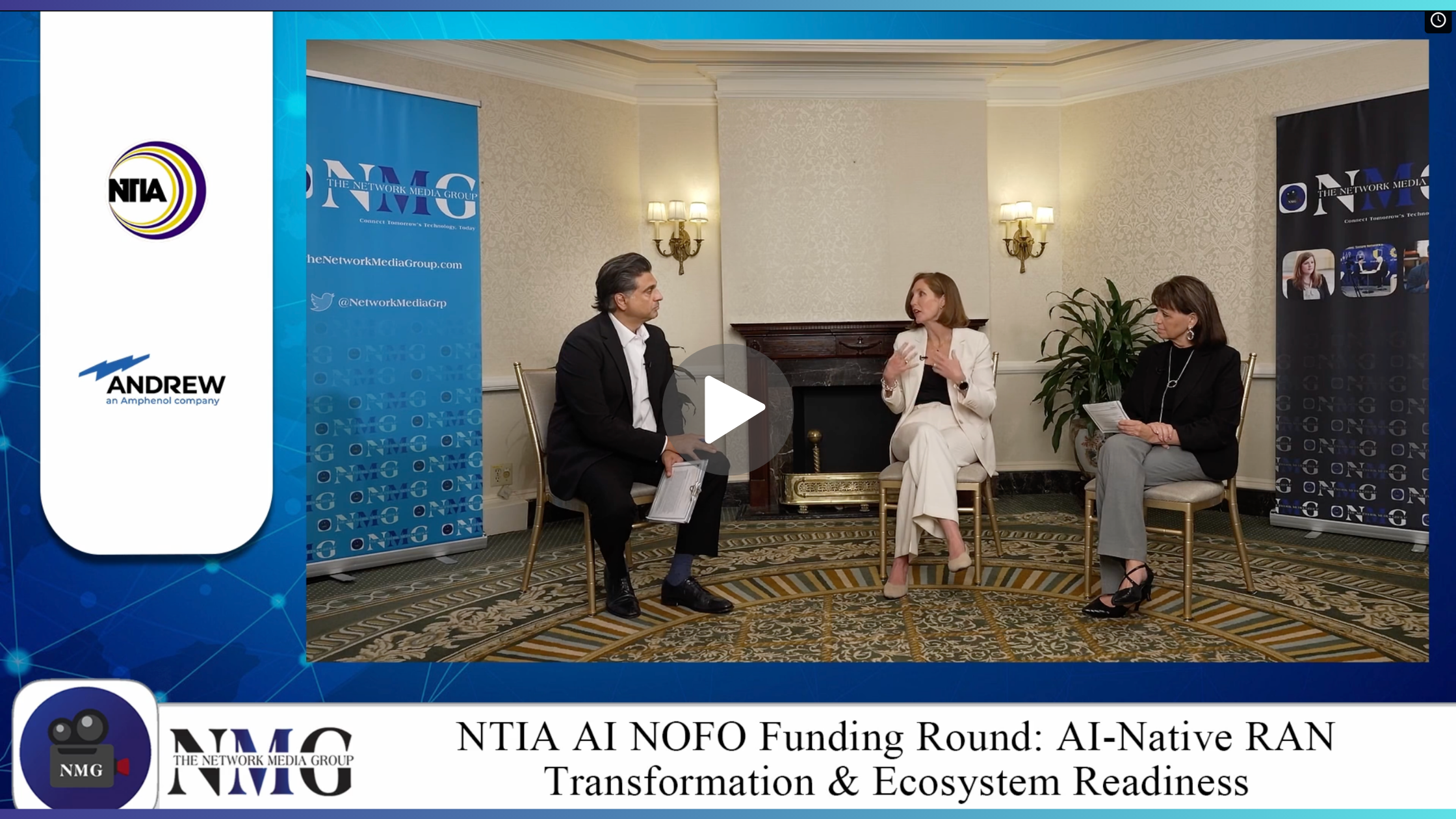
Amanda Toman - Director, Innovation Fund, NTIA
Darla Braun - SVP, Indoor Cellular Networks, ANDREW, An Amphenol company
tRANSCRIPTION
ABE: And the National Telecommunications and Information Administration, that's the NTIA, is preparing an upcoming notice of funding opportunity called NOFO under the Public Wireless Supply Chain Innovation Fund, marking a strategic pivot from traditional open RAN deployment towards AI-native radio access networks.
This session will help us gain insights into how the NTIA's continued funding strategy is really catalyzing collaboration across industry, research institutions, and technology providers that to advance AI-RAN innovation. Joining us are Amanda Tolman, she's Director of the Public Wireless Supply Chain Innovation Fund, that at the NTIA.
And next to her is Darla Braun, she's Senior Vice President, Indoor Cellular Networks, that at Andrew, and that's an Amphenol company. And welcome to the session.
AMANDA & DARLA: Thank you.
ABE: Thanks for being here. Darla, thanks for flying in from Dallas.
DARLA: Absolutely, love it.
ABE: And Amanda, thanks for walking over from the next block.
AMANDA: No problem.
ABE: Appreciate it.
ABE: Amanda, I wanted to start with you. Clearly, there's a shift here in priorities, or actually, maybe educate us. Maybe there's not such a shift from open RAN to AI-RAN from the NTIA's point of view. Tell us about that shift and then a little bit about the funding round that's coming up.
AMANDA: Yeah.
So thank you for having me today, Abe. So as you mentioned, we do have a new funding opportunity that just published on the 14th of July. And you are right, the title of it is AI-RAN.
I don't see, I see what we're doing in line with everything that the fund has been set up to do, right? The statutory objectives of the Public Wireless Supply Chain Innovation Fund remain the same. We're focused on how do we accelerate the commercial adoption of open and interoperable networks? How do we achieve U.S. leadership? How do we secure the supply chain, most notably so that there are U.S. players back in this ecosystem, the telecommunications ecosystem.
So what I think we've done as part of the innovation fund is really, well, one, we had to recognize the limitations we had, right? We had a billion and a half dollars to try to move an entire industry that is tens of billions of dollars a year. So just numbers alone, we had a challenge.
So how do we actually leverage the money that we had to make shifts in this behemoth of an industry? And, you know, I think we've tried to do that. We recognize it's been a challenge. And, you know, wanted to address the problem in sort of piecemeal.
So that's why we had the multiple NOFOs, right? You know, some people, you could have gone out and just blasted the billion and a half dollars from the get-go. But, you know, when I took over as the director, I really thought through how can we actually directly target some of these technology areas where we see gaps and make strategic investments so that we'd start the catalyst, really, for that ecosystem. So, you know, I think we've done that between NOFOs one, NOFO 2, and now NOFO 4.
Really getting at where we see industry going and how AI is going to impact every, you know, it's going to impact everything. But I think it'll have a really positive impact on telecommunications. And I see this shift possible or facilitated largely around this open and interoperable networks, right? So by opening the architecture, by moving towards more virtualization of the network, I think it inherently enables AI to be integrated more quickly. At least that's the hope.
ABE: I do want to get into more of the funding process for the audience so they can get a better context and a better handle of what that's all about and what's impending, what's coming up. But Darla, I wanted to go to you, maybe from an industry and maybe from a technology point of view.
Ah AI, and you mentioned this a little bit in your answer, AI impacting particular sectors in the industry, particularly in the wireless sector. What's your perspective on that and where are those impacts right now?
DARLA: So yes, we think it impacts it greatly. And we're very excited about this next step because we do see this as just the next chapter, not something dramatically different, not a shift even, just the next chapter. And so we actually see that this is going to have a huge improvement for both all the customers in the ecosystem. So there is a lot of ROI that we're going to get, for example, from the very first one's going to be a network performance. How do we get savings in the network performance? Because you want to see early indications that this is successful, what's happening.
And so that's going to be things like automating routine activities, self-configuration of network elements, automate, you know, defect and getting remediation for that. So you know, ka-ching, it's always about the money, right? How do we get savings? That's what will show that what has happened is really seeing that kind of impact. But also around the energy savings, for example, the energy savings, we already started it around, we've already seen some great gains, but again, this takes it to the next level because now AI is embedded in every single thing that we do, all parts of the network and the AI native, I mean, it really is embedded.
And so we're going to see more energy savings, which is very important to the industry. And even for like commercial real estate property owners, that's huge for them to have sustainability credits. So it impacts not just like the network operators. We're also thinking how it's going to impact end users as well. And also being, you know, an operational company, preventive maintenance is also a huge one. It's very labor intensive.
And so again, we're seeing short term, those are the benefits that's going to happen immediately. But the very exciting thing, I'm kind of a geek. The real exciting thing is going to be when we get to the RAN optimization.
So there's going to be what's called a radio resource management. It's going to be a tool that's going to be able to just continuously monitor the cellular signal and detect if there's interference, for example, or a high latency. And it will dynamically change, like the channels, the radio channels, it will change the power levels.
I have not, you can have no idea how much time this can take and see the benefit it's going to take. So I'm very excited when we see that happen. ABE: Yeah.
ABE: Darla, I wanted to stay with you and Amanda, I wanted you to jump on this as well. Certainly, there are business barriers to AI and AI RAN on the ecosystem. We talk about ecosystem readiness.
From your perspective, again, from industry, is the ecosystem ready for the technology that already exists in AI and AI RAN as well?
DARLA: That's a great question. Thanks. I mean, I'm not, I'm going to sit here and be honest.
I wish I could just say yes. Let's go. But the reality is there are some barriers that we've got to all really consider and work together.
This is all about collaboration, in my opinion, with the ecosystem. So some of the barriers, like technically, is just the data portability, for example. How is that going to work? How is that going to be governed? There's still a lot of people not into sharing.
And so that's a very key example of what's got to get overcome.
And then also, operationally, just our own skill sets. Do we have a workforce that can work in this? In fact, I actually did look at some of the AI platforms and said, how many technology geeks are there in the US? Just to see, guess what the percentage was? Between 17% and 25% are considered technology geeks, although it's not on the census.
And so anyway, but you've got to continue to increase that. But there's a lot of complexity when you think about it operationally. There are thousands and thousands and thousands of wireless networks out there, and hundreds and thousands of vendors like ourselves.
And now we're going to add some more complexity to it. So just figuring out all this operational perspective is a key challenge. I mean, that's one that we need to go deal with, but it's a key challenge.
And then thirdly, I would say business-wise, there is, I know it's part of the whole write-up that everybody's got to respond to, but how do you monetize this? How do you increase the revenue? And someone, I read somewhere, someone called it the ecosystem economics. There's a lot of people in this ecosystem now. How do they all make money, survive, and thrive in this environment? So those are a lot of the barriers that we've got to consider as we work through it.
So I wouldn't say yes, it's already today. I don't think that was the intention. It's going to take some time, but it's also, I see cultures have got to change inside of the industry.
Cultures have got to change that it's great to work together. Some of it already started happening in the O-RAN side, and it's forcing us people that may compete with them in one way, but collaborate with them in other ways. And we've got to continue to take that to other levels.
ABE.
I think the collaboration point you made is interesting. And Amanda, you've been involved in several rounds of funding for the telecom industry and the wider sort of tangential industries.
You had an experience with that O-RAN collaboration with industry, and now you're having, is it a different experience in the AI realm, or is it pretty much the same, just sort of same day, you know, different experience?
AMANDA: Well, I haven't seen all the applications yet, right? So the application window is still open. Right. I think what we recognize with this fourth and final funding opportunity is that given where technology has come, given where we see Open RAN has hit its challenges, quite honestly, right? Like adoption did not happen as we had wanted it to.
I think barriers have been broken down, and I think companies are collaborating. And I think we have had success there, right? You've seen that across the industry. But there are challenges that still remain.
But this opportunity to bring AI into the network more rapidly really is what we're trying to do with this fourth NOFO. I see this evolution happening. It could take 10 years.
Maybe I'm too optimistic here, but using this $50 million nugget that we have at NTIA to really put our foot on the gas and get there as quickly as possible to try to break down some of those barriers by continuing to bring industry together. You know, we saw many of the same players from Open RAN interested in the opportunity. But the hope is we bring some new players as well into this ecosystem.
So that I think there's an opportunity as we go to 6G to really transform the network. The idea that it's not just mobile and networking, but is there a way to actually combine them and make it this ubiquitous connectivity layer that powers everything and provides... It is completely transparent to a user whether or not your AR or VR headset is connected to a mobile or you're connected to Wi-Fi. However, that network is enabled and one would hope it's this AI native network architecture that's able to do that.
So the hope is, you know, that the existing players are part of the solution. We get new players into this ecosystem and really, hopefully, there are U.S. leadership and U.S. companies that are coming to the table.
ABE: Yeah, and that's hugely important, right? I mean, that kind of segues into sort of the next question.
But before we get there, you mentioned a July sort of milestone date for receiving applications. The deadline for receiving applications is? AMANDA: September 9th.
ABE: September 9th.
AMANDA: Yes.
ABE: Okay, and what happens after September 9th? Are there any other dates that we should be aware of?
AMANDA: So September 9th is the big deadline and all applications should begin and then it's work for my team to go through and begin reviewing and evaluating and making determinations about awards. ABE: And how long does that typically take?
AMANDA: Well, largely dependent on the volume of applications we get, but we're targeting probably the late fall for announcements around awards.
ABE: Okay, okay. Darla, if we were sitting here this time next year, post funding, this NOFO, next round of AI-RAN, AI funding, what would you hope the conversation could be about or would be about? What's your hope of where the industry should be? And would that be different than your experience during the Open RAN funding? And I know I keep going back to that, but I'm just trying to find a differentiation between the Open RAN experience and the AI-RAN experience.
DARLA: I think that's a great question.
I think the Open RAN experience was really still around a lot of manufacturers, us working with different ones, interfacing with each other, open interfaces. This takes it to a new level. So now you're interfacing with all these AI cloud providers.
So to me, it's very, very different. So that's why I think it takes it to a new level is because now we've got to broaden our scope, our thinking to partner with this bigger collaboration, because that's really what's going to take us to this next level.
ABE: And you see that happening, though.
DARLA: Yes. We're seeing lots of interest from within the industry. Now, There's the barriers, but I'm just telling you, there's lots of interest.
Everybody knows that this is the next step.
ABE: Absolutely. Amanda, anything to add about where we would, what would the discussion should be or would be about this time next year?
AMANDA: I hope we're well on our path to standing up a demonstration of capability.
And I hope that some of these challenges that Darla mentioned are starting to get addressed. I think the data exposure and access to data is going to be one of those really big challenges, right? Because how good is AI if you don't actually have access or exposure to data?
So ensuring that that is made possible and that hopefully we get applications where we have teams and industry players coming together to talk about how they're going to share that data, expose that data, and actually make it something so that you can really leverage AI natively.
ABE: Great.
And again, just for the audience, September 9th is the deadline for applications and then you're doing your work on your end and that rolls through late fall.
AMANDA: Yes.
ABE: I mean, theoretically.
(everyone laughs)
AMANDA: Yeah.
ABE: Okay. It was great having you, Darla.
Great having you again. You came down or you came up from Dallas.
DARLA: Came up.
ABE we appreciate that. Great to have representation from Andrew at the Amphenol Company.
DARLA: Yes. Thank you. That's a lot. Yeah.
ABE: Yeah And as always, Amanda, it's great to have you from the NTIA. You're very generous with your time. So we appreciate that.
AMANDA: Yeah. Happy to be here.
ABE: Thanks a lot.
DARLA: Thank you.
AMANDA: Thank you, Abe.
Sign up for Daily CommTech Brief here.
For any inquiries, please email anejad@thenetworkmediagroup.com