
Open RAN Meets Indoor Networks: Enabling the Future of In-Building Wireless
Transcription
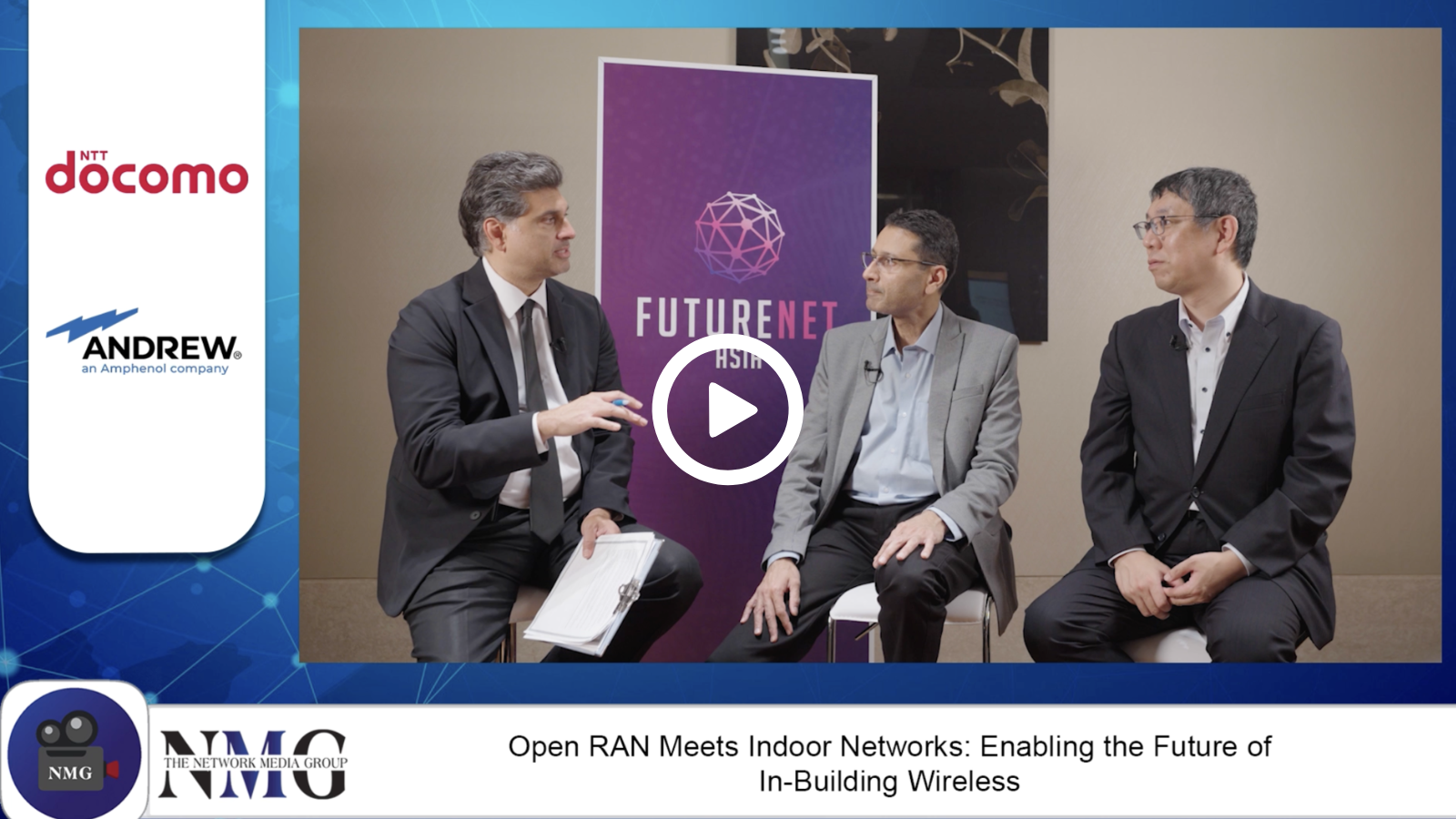
ABE: And this panel will explore the evolution from two complementary technologies. That's the transformation of RAN architectures and also AI native and autonomous networks. Together, the discussion will examine how these developments can connect the broader network architecture with the increasingly demanding connectivity needs of the enterprise.
Joining us are Yoshihiro Nakajima. He's director of the network virtualization platform that at NTT DoCoMo.
And next to him is Upendra Pingal. He's general manager, intelligent cellular networks, that at Andrew. And that's an Amphenol company. And gentlemen, welcome to the session.
UPENDRA: Thank you for having us.
YOSHIHIRO: Thank you.
ABE: Thanks for being here. Yoshihiro just came off a session here at FutureNet Asia. How did that go for you?
YOSHIHIRO: Yeah, I'm honored to share our experience of the AI native infrastructure to the leadership of the telecom, especially for Asian Pacific area.
ABE: Absolutely. I'd like to get more into that. In fact, if you don't mind, I'll start with you, Yoshi. Where are we sort of on the timeline of AI native networks for telcos and for their enterprise customers? And do you think we're moving at a pace that we should be?
YOSHIHIRO: Yeah, that is a good question for us. Because AI is a movement of AI is fundamental. And we are trying to push our team to develop the AI native infrastructure to our customers, the high quality and the robust network demands to our companies. And also automation is much, much important to us to provide our delivery much quickly to the business customers.
And to do realize such ideas, we are full advantage of the LLM, so the new AI technologies and some guidelines or harnesses to protect our infrastructure very safely and robust with the predictable actions of the AI.
ABE: Interesting. Upendra, I want to start with you on Open RAN or really any RAN architecture that's virtualized. As we move towards implementing these technologies into stadiums, any kind of venue, enterprise venue, campus and airport, what changes sort of fundamentally have to be made in order to accommodate those stadiums?
UPENDRA: So first of all, I would like to always start by this ironic situation that we find ourselves in as an industry, that if you think about any network, majority of the RAN spent, as you can imagine, happens on the outdoor macro side, but majority of the traffic happens to be on the indoor side. So we always find this a bit of a contradiction that the focus area, which is happening in the outdoor macro, we will believe that at some point in time, we'll start moving into indoors. To your point about stadiums and enterprises, those are, I think, the two broad categories when it comes to in-building, I would like to categorize.
Stadiums are where there is a finite number of venues, but there is an infinite number of capacity that is needed. Multi-operator, multi-band, you name it. Whereas enterprises, there is a particular use case that's there, but there is an infinite number of venues when it comes to enterprises.
So the question is, you talked about open RAN or some kind of a virtualized RAN. How do we leverage these technologies to be able to address those use cases for in-building applications? For example, the stadiums may care about space and energy. The enterprises may care about what they're used to in terms of Wi-Fi standards of the servers and all that.
So when you think about a virtual cloud-native technology, the question is, how do we cater to those use cases, be it in the stadium or be it in an enterprise environment? So that's where we are focused on. We are working on building a platform that allows us that flexibility to cater to all those requirements.
ABE: Yoshi, could you shed some light on how vRAN really impacts AI-RAN sort of on a fundamental level?
YOSHIHIRO: Yeah, I think that is a good question to the industry because we are trying to improve the radio quality to maximize the speed and connectivity to the devices.
So that would be nice to our customers to realize a very frequent communication to the others. So that is a fundamental aspect to be addressed in the telecommunications.
ABE: And Upendra,, when we're talking about Open RAN, a lot of times we're talking about macro networks and sort of your realm talking about it for indoor cellular networks. Can you again shed some light on the sort of the contrast there between the two?
UPENDRA: Yeah, so think about as we start thinking about 6G, for example, and I know we are a ways away from that. We are going to take on the build on the foundation of the 5G in terms of the latency, in terms of massive device connectivity, in terms of bandwidth. And if you think about all of those, when it comes to in-building, as the spectrum starts going up and up, going from 3G all the way to 6G, it becomes even more important that you got to have a dedicated flexible platform to serve indoor because as the frequency goes up, obviously, the ability of that spectrum to go inside is going to be diminished, which means you got to have something very specific to cater to that. Number one.
Number two, in your presentation just now, you talked about something very important that I made a note of, that a lot of times the operators may not have the visibility into the network. So for you to apply AI and bring about automation and an autonomous network, you got to have a full visibility.
For in-building, full visibility means that you need to have some kind of a platform that is fully digital, that can give you visibility all the way from the edge of the network back to the RAN, back to the CUDU and back to the core. And if you think about the traditional DASes, especially if you think about the RF led analog DASes, you just don't have that. Because the visibility stops at a certain point in time.
So for Docomo to be able to put that AI implementation, if you don't have the visibility, then that's going to be a problem, which is where we are trying to put our focus on. How do we create a complete end-to-end open digital network architecture so that you have the full visibility and now you're able to implement all those LLM models and drive the network?
ABE: Yoshi, as AI becomes more part of the network sort of day by day here, where does that AI processing really happen? Is it central cloud, edge, the RAN infrastructure, or is it a combination?
YOSHIHIRO: Yeah, I think the hybrid approach is mandatory. So we are trying to make a much more complex problem solving.
So we need a massive scale of the AI infrastructures. But in some use cases, like in network computing, the device or network function should spread to the edge side. So we are trying to make a hybrid approach to minimize the cost and maximize the expectations of our customers' demands to the network.
ABE: And Upendra, of course, indoor environments are increasingly needing these predictable high-capacity connectivities for AI, IoT, and such. So where does that leave you sort of in the value chain here as far as those necessities that indoor environments need?
UPENDRA: Yeah, so let me just build on what I said earlier. Taking from the 5G tenants, if you add the accelerated requirements for the 6G applications, you'll find that more and more of those applications that the operators can monetize will come in indoor, right? I mean, you're talking autonomous factories with the robots connected to each other. You're talking about logistics, warehouses, you're talking about retail stores, and the use cases that you can monetize are just unlimited, right? So the question is, how do we create that infrastructure, right? Because if you have a platform that is disaggregated, I mean, we talked earlier about the three pillars that you mentioned, the development, the deployment and operations. If I'm able to provide an infrastructure that is seamless, that flows through the development, deployment and operation aspects of it, then you as the end customer, you as the end operator will be able to put all those things that you're talking about on that infrastructure. So the onus actually comes to me to make sure that I define an architecture, I come up with an architecture that Docomo can actually implement seamlessly, and they're able to actually do all those things that they talk about, in terms of implementing all the LLMs, they can do that. Because otherwise, it stops at some place. Otherwise, it may stop at just development, you want to be able to go all the way through, and then use that root cause analysis to predict the future and what can go wrong and fix it before it goes wrong. I talked about maybe there's some kind of a soft failure that we can launch in anticipation of something can fail.
So where I'm going with this is we are building an architecture that can provide that seamless connectivity, that can provide that end-to-end visibility for the operator, so they can go and do all those things that you want to do.
ABE: Interesting. Yoshi, I want to go back to you on network deployment and operations that can be automated today, and what remains difficult for you to automate today?
YOSHIHIRO: That is hard to answer. Of course, we are trying to proceed the LLM automation to the production network from day zero, day one, day two. And sometimes we have some trouble or concern on the undocumented limitations and some rules. So we need to find such kind of unclear conditions or rules to ask our field engineers.
So what are you thinking for the dedicated procedures or dedicated design or dedicated network system? So we are trying to identify one by one to document the rules, the design, everything to the one places. And after that, so we can easily automate everything through the by-recording, LLM. So that will be nice to our operator to automate the end-to-end procedures.
ABE: Yeah. So Upendra, do you see that one day soon that indoor cellular networks could deploy and be managed just as easily as maybe enterprise Wi-Fi today?
UPENDRA: It has to be that way. Let me go back to the initial conversation that we had. Traditionally, when people think about indoor, they think about big stadiums, airports, train stations, the big venues, large public venues.
And like I said, those are finite number of venues. And while they test the limits of an indoor cellular network in terms of all the capabilities, there is only a finite number of them. If you think about going and deploying, you can send a team of engineers there.
You can go develop that, do the site survey, do the design, send people for installation commissioning. Now take that to enterprises, those enterprises that for decades are used to using Wi-Fi, is their IT team that is building Wi-Fi. They're used to something very simple, something that they actually don't want to even see.
Now you go and put a cellular network in there. And if you try to go apply the same logic that you applied for stadium, it's just not going to work. So talking about automation and everything that you mentioned in terms of the need for automation, actually the need for automation is absolutely necessary when it comes to enterprises. Because if I want to deploy cellular network in millions of buildings, just like Wi-Fi, there is no way I can do that manually. It has to be done automatically. The only thing that happens is just think about the Wi-Fi, the Wi-Fi kit comes at home and you just do it everything on your own.
Imagine on a cellular basis, the kit comes to you and then we are actually just remotely sitting and deploying that, automating that, upgrading that, and basically evolving that to what the requirements are. And if you're going from 5G to 6G, maybe you can upgrade that on the same band. We can upgrade that remotely to go from 5G to 6G with a software upgrade. Those are the requirements for enterprises.
So back to your question, they have to be simplified like Wi-Fi, but end of the day, they need to be connected back to the operators. So you can implement all those great things that you talked about earlier.
ABE: Upendra, based on just your comments right there, what timeline are we talking about to achieve this sort of end-to-end architecture that includes all these technologies?
UPENDRA: So we are working on it as we speak. This is not something that is far down the future. If you think about what we have done at Andrew, it's been more than a decade that we have been working on and deploying digital architecture. So that's been going on. The next step of that we've been deploying direct baseband connectivity with a bunch of different OEMs. So that's been going on for another decade.
And then the next step is going to be converging the architecture. So applying that automation, applying that AI logic to this converged architecture and taking in the future. So we are not talking five years down the line. We are actually talking months down the line. Because when we think about private networks, AI and 6G, it's all somehow converging in the next couple of years now. So it needs to happen right now.
ABE: Yoshi, would you say that the enterprises, whether they are small, medium or large enterprises, are aware of what's coming down the pike as far as AI native networks and how that can impact their businesses? And if they are not aware, what can we do to make them aware? Certainly a large part of the pie for telcos to be involved in.
YOSHIHIRO: I think the speed of the deployment and maintaining by no human intervention is much, much important to a massive scale. So from the operator's point of view, it's very difficult to well tailor the operations, well tailor the deployment to the customer.
It's much, much cost-efficient. And we are trying to automate by AI technologies to realize the fast deployment, fast upgrade, fast root cause analysis and the next actions. So that will be an essential capability that the operator needs to implement as soon as possible.
ABE: Upendra, in an ideal world, if we're sitting here this time next year talking about indoor cellular networks, what would you wish or hope that we would be talking about at that point? Ideally, ideally.
UPENDRA: So ideally what I would like to see is people start thinking about indoor more as a focus area. And I want to start, I want to go back to where I started.
The RAN spend happens more on the outdoor macro, whereas the applications and the data throughput is happening more and more indoor. So I would like the industry to see that the monetization opportunities for indoor are a lot more than what we have seen traditionally. Everything that we talked about in terms of automation will come to a fruition in enterprise world. And that's where the unlimited requirement and unlimited opportunities are.
So when we think sit here in a year down the line, I would like to see as an industry, we're spending a lot more time talking about enterprises and indoor cellular connectivity in general. So that we can all get the benefit. And we talk about monetization and a lot of concerns about monetization. But I think when we think about these things that we just discussed, there is a huge opportunity for us to monetize that. And I think that's going to be a lot in the stadiums and airports and enterprises and hospitals and retail stores.
So I'm pretty excited about it.
ABE: Yeah, I really think that's where the opportunity is in the enterprise sector and market. And that's something that I think telcos are really noticing as we as an ecosystem are noticing over the last couple of years.
So a lot of opportunity and runway there, I would say.
Yoshi with NTT DoCoMo, we very, very much appreciate your time and your insight. I know you're busy here at FutureNet Asia.
And we hope to do this again and have the discussion that Upendra just referenced this time next year.
YOSHIHIRO: Thank you.
ABE: Thank you so much for your time.
And Upendra, thanks for supporting the session. And thanks for, again, your insights and your time as well.
UPENDRA: Thank you very much.
ABE: Thanks so much. We'll do this again.
Sign up for Daily CommTech Brief here.
For any inquiries, please email anejad@thenetworkmediagroup.com